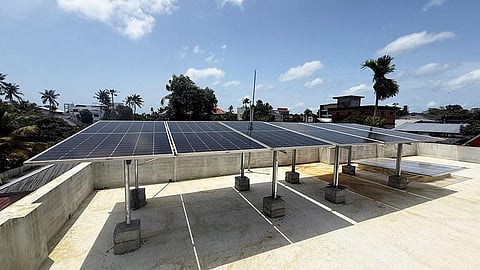


The Asian Development Bank (ADB) has approved an $850 million loan to support India's flagship rooftop solar scheme, Pradhan Mantri Surya Ghar: Muft Bijli Yojana (PMSGMBY). ADB has approved the financing under subprogram 2 of the Accelerating Affordable and Inclusive Rooftop Solar Systems Development Program. It will help expand rooftop solar installations, improve grid readiness, attract private investment, strengthen workforce skills, and support domestic manufacturing and recycling. It will enable lower upfront costs and increase adoption under the program, while supporting the training and certification of at least 6,000 people.
Through the PMSGMBY program, India aims to achieve 30 GW of residential rooftop solar capacity by FY2027 while expanding access to affordable clean energy and reducing emissions. Recently, the World Bank approved $890 million for the program (see World Bank Backs India Rooftop Solar With $890 Million).
AMPIN Solar ONE, a joint venture between AMPIN Energy Transition and Jupiter International Limited, has come online. The JV recently rolled out the first solar cell from its Odisha-located factory. The JV was announced in October 2023 with the target to set up a 1.3 GW solar cell and module production plant under PLI tranche-II (see GW-Scale Solar Manufacturing Joint Venture In India). Jupiter says this expands the company’s cumulative solar cell manufacturing capacity to 4.5 GW and module capacity to 1.5 GW. In February 2026, Jupiter commissioned a 1 GW mono PERC solar cell manufacturing line in Himachal Pradesh. In June 2026, it started TOPCon cell production with a capacity of 1.25 GW.
LNK Energy has achieved financial closure for Phase 1 of its planned 6 GW integrated solar manufacturing facility with the State Bank of India (SBI). The project, to be developed in Maharashtra, will include integrated production of ingots, wafers, solar cells, and modules. The 6 GW facility was announced earlier as part of LNK Energy's plans to establish a fully integrated solar PV manufacturing complex (see LNK Energy Targets 6 GW Integrated Solar PV Manufacturing).
India's Ministry of New and Renewable Energy (MNRE) has released the 8th revision of the Approved List of Models & Manufacturers (ALMM) List-II for solar PV cells. The update adds Avaada Electro Ltd. as a new manufacturer and approves a capacity expansion for Fujiyama Power Systems Ltd. Under the latest revision, Avaada Electro's Nagpur, Maharashtra facility has been listed with 610 MW/year of n-type TOPCon solar cell manufacturing capacity, while Fujiyama Power Systems' Uttar Pradesh facility has received approval to increase its capacity to 1,077 MW/year for bifacial mono PERC solar cells. The revised list is effective from July 22, 2026. With this update, India’s ALMM List-II-enlisted solar cell capacity, including RenewSys’ 452 MW in the 7th revision, now expands to about 31.6 GW.
Bondada Engineering has acquired a 60% stake in Onix IPP Private Limited (OIPL), securing a controlling interest in a 225 MW (AC) solar power portfolio. The project is being developed under the PM-KUSUM Scheme in Maharashtra. It has a 25-year power purchase agreement (PPA) with Maharashtra State Electricity Distribution Company Limited (MSEDCL) and is expected to generate annual revenue of around INR 150.48 crore. The company said the acquisition supports its strategy to build recurring, annuity-based revenue from renewable energy assets. Separately, Bondada also received approval from the Central Electricity Authority (CEA) to energize a 300 MW grid-connected solar project in Khavda, Gujarat. It is executing the 300 MW facility on an EPC basis for NLC India Renewables Limited. The approval enables the project to move toward grid energization.
ENGIE has achieved financial closure for its 250 MW Khaba Solar Project in Barmer, Rajasthan. The project, being developed through its wholly owned subsidiary, Khaba Renewable Energy Private Limited, has secured financing from global financial institutions to support its next phase of development, according to the company. Construction is expected to be completed by Q3 2026. Once commissioned, the solar project is expected to generate around 650 GWh of electricity annually.
