

India’s Union Budget 2026 raises solar allocation by 32% YoY to over INR 30,539 crore, the largest share within MNRE’s expanded budget
PMSGMBY receives INR 22,000 crore, while PM-KUSUM funding nearly doubles to INR 5,000 crore
Basic customs duty exemptions for key inputs like sodium antimonate and lithium-ion cell manufacturing aim to strengthen domestic solar and storage manufacturing
The Indian solar industry has reason to celebrate, as the Union Budget 2026 has increased its allocation by 32% year-over-year (YoY) to a total of INR 30,539.36 crore. This is an increase over the INR 24,224 crore allocated in the previous financial year (FY) (see Union Budget 2025: India Reduces Tariffs on Imported Solar Cells and Modules).
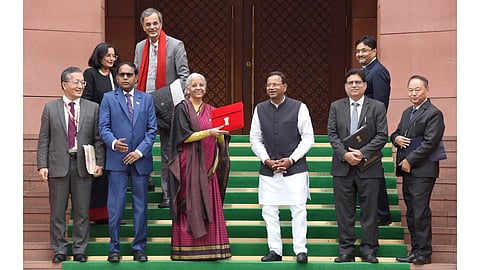
The lion’s share of India’s solar budget for FY 2026-27 of INR 22,000 crore, presented by Indian Finance Minister Nirmala Sitharaman, has been reserved for the government’s flagship rooftop solar PV scheme, PM Surya Ghar Muft Bijli Yojana (PMSGMBY). In the last budget, its share was INR 20,000 crore.
Launched in February 2024 with a target to provide up to 300 units of free electricity every month for 1 crore or 10 million households with INR 75,021 crore or INR 750 billion total outlay, the PMSGMBY aims to achieve 30 GW of installed rooftop solar capacity (see India Eyeing 30 GW Rooftop Solar Capacity With New Scheme).
At the end of December 2025, nearly 24 lakh (2.4 million) households had adopted rooftop solar under the PMSGMBY scheme, representing a combined 7 GW installed capacity.
Another big beneficiary of the budget is the Kisan Urja Suraksha evam Utthan Mahabhiyan (PM-KUSUM) scheme that will receive INR 5,000 crore – an increase over INR 2,600 crore in the previous FY. On-grid solar has secured INR 1,775 crore.
Introduced in 2019 to encourage solar PV in agricultural use, PM-KUSUM reported over 9 lakh standalone solar pumps under component B, and 10,535 grid-connected solar pumps along with the completion of 9,74,458 feeder-level solarization (FLS) pumps under component C, till October 2025. The government had revised the solar PV capacity target under this scheme from 25.75 GW to 30.8 GW. Its achievement, previously targeted for 2022, has now been revised to March 31, 2026.
Solar gets the largest chunk of the total budget allocation (INR 32,914.67 crore) for the Ministry of New and Renewable Energy (MNRE), which is a 24% increase over the previous FY. The National Green Hydrogen Mission also lands INR 600 crore.
One of the biggest headlines for the solar PV manufacturing industry in the latest budget is the basic customs duty (BCD) exemption for the import of sodium antimonate, used in the manufacture of solar glass. This is aimed at reducing production costs and improving raw material availability for domestic manufacturers.
MNRE hailed the move, stating, “This step supports stronger solar manufacturing, improved competitiveness across the value chain, and faster expansion of solar power capacity — reinforcing India’s energy transition and energy security goals.”
The budget also exempts BCD on capital goods used to manufacture lithium-ion cells for battery energy storage systems (BESS), aimed at reducing costs for grid-scale storage to boost renewable energy. Additionally, the BCD exemption is also extended to imported goods required for nuclear power plants till 2035.
Industry Welcomes Budget Promises
“Both these measures can aid in the tariff competitiveness of BESS as well as nuclear power projects in India. Further, increased allocation on PM Surya Ghar Muft Bijli Yojana and continued focus on PM Kisan Urja Suraksha evam Utthaan Mahabhiyan will support the renewable capacity addition in the country,” said Vice President and Co Group Head - Corporate Ratings, ICRA, Ankit Jain.
He added, “Additionally, the tax relief towards data center investments for foreign entities providing cloud servicing from India is likely aid the renewable capacity addition, given the sustainability focus.”
Avaada Group Chairman Vineet Mittal welcomed the budget, saying it strikes a balance between ambition, growth, and discipline. He stated, “With sustained public capex of ₹12.2 lakh crore, a clear fiscal consolidation path, and reforms like the Infrastructure Risk Guarantee Fund, it focuses on building long-term productive capacity rather than short-term stimulus. The emphasis on infrastructure, MSME scaling, transport, digital and logistics readiness sends a strong signal that India is investing for durable growth, competitiveness, and investor confidence.”
The Chairman and Managing Director at Hero Future Energies, Rahul Munjal, believes the targeted BCD exemptions for lithium-ion cells, BESS, and key clean-energy manufacturing inputs will help scale domestic capacity and improve project viability.
The National Solar Energy Federation of India (NSEFI) sees the 2026 budget as signaling strong government support for the renewable energy sector, as it also promises improved access to finance.
Saatvik Green Energy CEO Prashant Mathur said that the budget gives clarity to the industry and effectively “locked in long-term domestic demand for solar” with the nearly 29% increase in the budget for PMSGMBY.
“The global clean-energy supply chain is being reshaped. The “China+1” opportunity is real but it will be captured only by countries that can combine scale, reliability, cost competitiveness and manufacturing depth,” added Mathur. “Budget 2026 positions India to do exactly that.”
TaiyangNews is bringing together the Indian solar PV manufacturing industry at the Solar Technology Conference India 2026 (STC.I 2026) on February 5 and 6 in Aerocity, New Delhi. This 2nd edition of the TaiyangNews physical conference will also have banks, investors, and policymakers in attendance. Register for the event here.
