

Indonesia will require up to $78 billion over the next 5 years to deliver the 100 GW of solar PV capacity target, according to a new report
It is structured to be realized as 20 GW of utility-scale and 80 GW of decentralized systems, supported by 320 GWh of battery storage
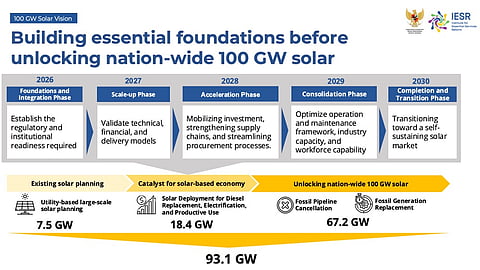
An initial 26 GW deployment phase is possible with utility and rooftop solar installations, along with electrification and diesel replacement projects
Achieving the target will depend on early retirement of aging coal and diesel plants, and cancellation of new coal projects
The report recommends a 180-day action plan, including regulatory support, financing mechanisms, and standardized mini-PPA models
It also calls for scaling domestic solar manufacturing and accelerating BESS assembly to support the target achievement
Indonesia will need up to $78 billion over the next 5 years to support the 100 GW solar PV capacity target, according to a new report outlining the scale of investment required to meet President Prabowo Subianto’s mandate. The report also highlights the importance of integrating battery energy storage systems (BESS) for grid stability and reliable power supply.
The targeted capacity is planned to be realized as 20 GW of centralized utility-scale solar PV projects and 80 GW of decentralized projects along with 320 GWh of BESS capacity, spread across 80,000 villages with the involvement of Koperasi Desa Merah Putih (KDMP) (see Indonesia Announces 100 GW Solar Power Capacity Plan).
A new report, titled The Solar Archipelago: Indonesia’s 100 GW Leap to Energy Sovereignty, prepared by the Institute for Essential Services Reform (IESR) in collaboration with Indonesia’s Coordinating Ministry for Economic Affairs, proposes strategic pathways to accelerate the achievement of the target.
Authors of the report believe that the strategy should be to accelerate the phased retirement of high-cost, high-emissions diesel power plants, and develop village-level solar energy systems to support KDMP.
As of 2025, Indonesia’s cumulative installed solar PV capacity reportedly reached 1.49 GW with the addition of 546 MW last year. By 2030, the country has planned 7.5 GW of total solar project capacity across both utility and rooftop solar, including captive consumption. Adding 11.8 GW through electrification and productive use, and 6.6 GW through diesel replacement, the report says it can deploy 26 GW in the initial phase. Falling solar prices and improving economics serve as the basis of this recommendation. BESS can also expand to 88.4 GW by the end of this decade.
“This initial phase will serve as the foundation for accelerating deployment prior to full national integration toward the 100 GW target. The remaining capacity required to achieve the 100 GW goal must be incorporated into PLN’s RUPTL,” said IESR Head of Energy System Modeling and Analysis, Alvin Putra Sisdwinugraha.
Indonesia has committed to adding 42.6 GW of new renewable energy capacity, including 17.1 GW of solar, under its Electricity Supply Business Plan (RUPTL) 2025-2034 (see Indonesia To Add 42.6 GW Renewables By 2034 Under RUPTL).
Achieving the 100 GW target will hinge on accelerated retirement of aging, inefficient coal-fired power plants before 2030, as well as the reduction or cancellation of planned new coal-fired power projects, added Sisdwinugraha.
The report writers recommend a 180-day action plan to get things started, beginning with a Presidential Regulation or Instruction to establish a task force and implementing body; publishing standardized mini-PPA models; and allocating funding from the state budget and international sources.
It will need to be followed by capitalizing the Village Energy Facility (VEF) at PT SMI and signing National Framework Agreements to secure retail pricing and supply chains for PV modules and BESS.
Support Manufacturing
The report writers recommend that the government simultaneously focus on boosting domestic solar supply chain manufacturing to support the 100 GW target. Indonesia’s existing domestic solar PV module production capacity of 14.6 GW is sufficient, but BESS will need to accelerate.
It calls for an industrial roadmap for solar PV and BESS with aggressive annual targets, fixing 50% local content requirement for PV modules and increasing it to 70% by 2028.
The government can implement an import-parity subsidy that can be gradually phased out. It can also encourage local assembly of BESS packages and import of cells. Local industrial capabilities for battery cell manufacturing can be built post-2028, if there is enough guaranteed demand from the long-term rollout of the 100 GW program.
Highlighting the country’s 7.7 TW technical solar energy potential, IESR Chief Executive Fabby Tumiwa stressed that the country can transition from a fossil-fuel-dependent economy to a renewable energy leader in Southeast Asia.
“With robust delivery framework, the 100 GW solar program has the potential to deliver reliable and affordable electricity to tens of millions of citizens, reduce fuel subsidy expenditures by up to IDR 21 trillion, mobilize between USD 50 and 70 billion in solar investment, create approximately 118,000 green jobs, and contribute significantly to reducing greenhouse gas emissions by up to 24 million tons of CO₂ equivalent,” added Tumiwa.
The complete report is available on IESR’s website for free download.
