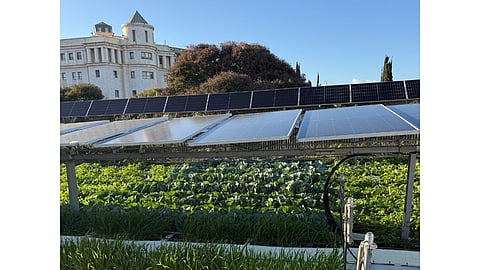


The government in Israel has approved a national agrivoltaics plan that establishes clear regulatory, design, and licensing standards for large-scale projects
The plan introduces a separate approval process for agrivoltaic systems; requires continued active farming for project operation
Following the approval, the government cleared a proposal allowing Enlight Renewable Energy to advance 300 MW of agrivoltaic capacity with storage near the Gaza border
The Israeli government has approved a national plan for agrivoltaics that provides a framework for the development of such projects combining solar power generation with agricultural activities, sans subsidies.
It lays down a set of comprehensive rules, design standards, and licensing standards for large-scale agrivoltaic projects to be deployed across the country while preserving the landscape and rural land. This will provide regulatory certainty to investors and the industry, the administration stressed.
The projects are also expected to support climate resilience by shading crops, reducing water use, and helping them cope better with changing weather conditions.
Under the plan, the government has created a separate approval process for agrivoltaic projects, different from regular ground-mounted solar plants. Ongoing active farming is a condition for the continued operation of solar power facilities, with monitoring and penalties to ensure proper agricultural use.
Initiated by the Ministry of Energy and Infrastructure and Planning Administration, the plan was earlier cleared by the National Planning and Building Council.
“In an era of climate change and increasing energy needs, agro-voltaic technology makes it possible to preserve open areas and prevent them from becoming infrastructure facilities only,” said the Director General of Planning Administration, Rafi Elmaleh. “Approval of the plan is a significant milestone, but it is part of a broader process that we are leading within the framework of the regional plans that are currently being promoted.”
Following this announcement, the government gave its approval to the Ministry of Energy and Infrastructure’s proposal to allow Enlight Renewable Energy to develop National Infrastructure Plans (NIP) for 300 MW of large-scale agrivoltaic capacity, along with storage addition, near the Gaza border.
These projects with 150 MW installed capacity each are proposed to be built on agricultural land in the moshavims of Maon, Carmel, and Beit Yatir in the Merhavim Regional Council area, and in Yated, Talmei Yosef, Dekel, Shadi Avraham, and Peri Gan in the Eshkol Regional Council area near the Gaza border.
The ministry said this will help restore the Tekuma region. Power generated will be supplied to the national electricity grid. These projects will contribute to the national goal of meeting 30% of its electricity production through renewables by 2030.
Israel is already advancing solar through rooftop PV. It earlier exempted building permit requirements for small-scale storage systems for the residential segment, mandated rooftop solar systems for new buildings, and also announced plans to solarize its sports fields (see Israel Eyes Up To 600 MW Solar Boost From Solarized Sports Fields).
