

Japan’s METI plans a JPY 210 billion subsidy program from FY2026 for factories and data centers using 100% locally sourced carbon-free electricity
Flexible perovskite solar cells will also qualify for support as per reports, aligning with Japan’s target of installing 20 GW of perovskite capacity by FY2040
The initiative contrasts with the LDP’s proposal to cut FIT/FIP support for solar projects above 1 MW
The Ministry of Economy, Trade and Industry in Japan intends to launch a JPY 210 billion plan to boost clean energy uptake in the country. Its focus is on expanding the use of renewable energy and nuclear power.
Under the plan disclosed by the Director of the Green Transformation (GX) Policy Group, Juntaro Shimizu at the ministry, as reported by the local media, the scheme is scheduled to be launched in fiscal year 2026 and will run for 5 years.
Factories and data centers that use 100% carbon-free electricity from local clean energy sources will be eligible for subsidies under the scheme that will cover up to half of their capital expenditure.
According to Nikkei Asia, power generation from flexible perovskite solar cells will also qualify. It is also aimed at transforming abandoned petrochemical complexes into new industrial bases. Applications will be invited from eligible businesses next year.
Nevertheless, this news comes in the wake of Japan’s ruling party, the Liberal Democratic Party, proposing to cut subsidies for solar PV projects with more than 1 MW of installed capacity.
In a recent statement, the party said it will consider future support for mega solar power plants, including its abolition, since technological progress and falling costs have already made solar competitive. It then requires little need for continued support under the feed-in tariff / feed-in premium (FIT/FIP) mechanism.
Such support will only be available for rooftop solar, community solar, and for perovskite and tandem solar cells. Agrivoltaic projects will also be assessed for their compatibility with agriculture.
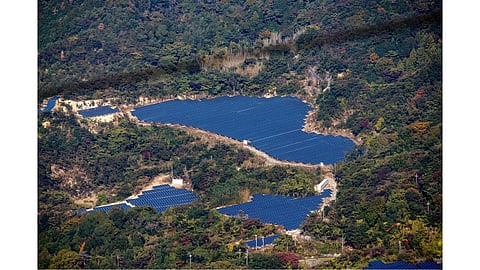
The party states that it is important to preserve Japan’s beautiful land and curb environmental destruction caused by deforestation and inappropriate development.
LDP Head and Japan’s Prime Minister Sanae Takaichi had reportedly previously expressed her dislike for foreign-made solar panels on Japanese land. A lot of them currently come from China, with whom Japan is in a conflict-like situation, most recently for geopolitical reasons.
Japan targets a 40% to 50% share of renewable energy in its total electricity mix by FY 2040 under its 7th Strategic Energy Plan, up from 22.9% in FY 2023. The plans include 20 GW of perovskite solar cell capacity that can be installed on roofs and building walls with low load-bearing capacity (see Japan To Aim For 20 GW Perovskite Solar Cell Capacity By 2040).
According to a November 2025 Institute for Energy Economics and Financial Analysis (IEEFA) report, Japan sees an opportunity in perovskite to regain its competitiveness in solar technology vis-à-vis China and other countries, especially since no country holds an authoritative position in perovskite technology as yet. Japan’s bet on perovskite is also backed by the country’s position as the 2nd largest producer of iodine, a key input for perovskite solar cells.
