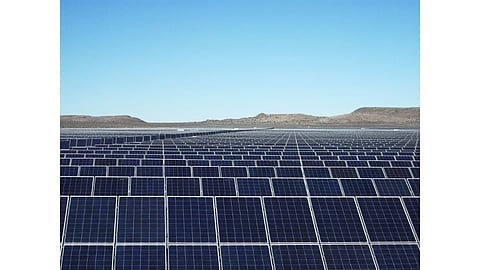


Angola has become home to Africa’s ‘largest’ off-grid solar installation, with 31.85 MW of PV and a 75.26 MWh battery energy storage system (BESS) capacity. The Luau Photovoltaic Park was recently commissioned by Portugal-based MCA. Together, the solar and storage components fully replace diesel generation in the village of Luau. It is completely off-grid and autonomous. Equipped with more than 54,000 solar panels, the project will supply clean power to over 90,000 people.
The transition is also expected to deliver major economic and environmental benefits to the region. MCA says the project, inaugurated by Angola’s President João Lourenço, takes the mantle of the largest off-grid solar park in Africa from the company’s previous project with 25.40 MW solar PV and 75.26 MWh BESS, commissioned in December 2025.
EDF Power Solutions has achieved financial close for a 265 MW solar PV plant near Dimona. It calls this the largest project of its kind ever in Israel. The project, spanning over 3,100 dunams in the Negev Desert, will deliver electricity at a price of under 6.5 agorot, one of the country’s lowest solar tariffs ever, according to local media reports.
To be developed under a 25-year public-private partnership, the plant will be designed, constructed, financed, and operated by EDF. The company won the project in a competitive solicitation process launched as part of the country’s target to achieve a 30% share of renewable energy in its electricity mix by 2030. It will also address the growing electricity demand from industries such as data centers and AI-driven operations, according to officials.
The Zambia Development Agency (ZDA) and Sunshare Energy Limited have signed a $246 million investment agreement for Phase II of the Nambala Solar Power Plant in Mumbwa, adding 250 MW to the project. Together with Phase I, the facility will reach 350 MW and a total investment of about $300 million, supporting Zambia’s plan to expand national power generation and improve energy reliability for key sectors.
In a separate development, Zambia also secured a $1.5 billion commitment from China Machinery Engineering Corporation (CMEC) for a 900 MW mixed-energy portfolio. This includes 300 MW of solar, wind, and coal capacities each. These projects will support the country in expanding its electricity generation capacity to 10 GW by 2031.
The European Bank for Reconstruction and Development (EBRD) has signed a memorandum of understanding (MoU) with various ministries in Jordan to support the country’s energy transition. The framework focuses on expanding renewable energy and battery storage capacity, modernizing the national transmission grid, and improving NEPCO’s financial and operational stability.
Under the agreement, the EBRD will help Jordan prepare tenders for renewable energy and storage. It also aims to support reforms in the electricity sector and advance Jordan’s low-carbon pathway, including the development of green hydrogen with plans to position Aqaba as a regional hub. The bank may consider financing future green hydrogen projects in the country. Jordan aims to generate 50% of its electricity from renewables by 2033, and the MoU supports this target, as per the bank.
