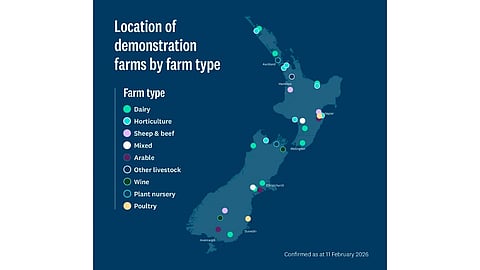


EECA has chosen 32 farms under its Solar on Farms program, representing a combined solar capacity of 3,616 kW across 10 different farm types
The funding call received over 230 applications, with selected farms receiving 40% support for inverters and batteries and 20% for the remaining solar system costs
All projects will be operational by July 2026, with EECA collecting performance data for up to 3 years to assess feasibility and challenges for further scalability
New Zealand’s Energy Efficiency and Conservation Authority (EECA) has selected 32 farms under its Solar on Farms initiative to demonstrate the benefits of solar and battery storage technologies across various industries. These farms represent a combined solar capacity of 3,616 kW.
It received an overwhelming response to the funding call with more than 230 farms applying to demonstrate solar and batteries. The 32 farms selected will receive partial funding covering 40% of the cost of the inverter and battery, and the remaining 20% for the rest of the solar PV system.
“By incorporating battery storage and managing network impacts, we’re helping create a long-term pathway for scalable renewable uptake, while setting farmers and growers up for long-term success,” said EECA Group Manager Delivery and Partnerships, Richard Briggs.
EECA’s early modeling showed that if 30% of the Kiwi farms installed larger systems, they could generate up to 10% of the national electricity demand.
“Solar and batteries together provide a possible solution to significantly reduce the vulnerability of important domestic and export sectors. Plus, vital systems like chillers and irrigation often use a great deal of power and could be making the most of solar energy during the day,” added Briggs.
Demonstration farms cover 10 different farm types, including dairy, sheep and beef and other livestock farms, poultry, arable, horticulture, plant nurseries, and wind. These farms host solar generation and battery storage systems, each ranging from 30 kW to 500 kW capacity, while some will be installing such projects under the program.
All the systems will be up and running by July 2026. EECA will collect data from these facilities for up to 3 years, which will be evaluated and insights derived to inform tailored feasibility and case studies. It will help identify challenges and limitations to the further uptake of such technologies across the country.
The complete list of the 32 selected farms and their funding amount is available on EECA’s website.
