

New Zealand has launched a review to simplify approvals for residential and small-scale solar systems
Current installation processes can take months due to multiple approvals and site visits
The government is studying faster Australian approval models, including 24-hour approvals for low-risk systems, and plans to replicate the same for the country
Taking a leaf out of some parts of Australia approving low-risk solar installations within 24 hours, New Zealand is looking to replicate a similar model, aiming for ‘lightspeed’ approvals for small-scale solar in the country.
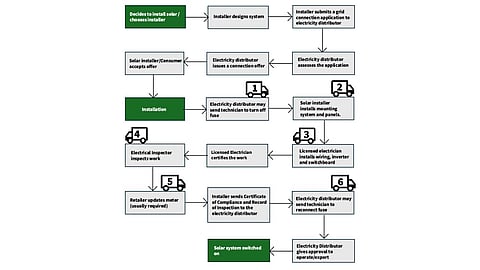
Calling solar installation in the country a ‘red tape nightmare’, as approvals could take months, New Zealand’s Regulation Minister David Seymour pointed out, “In New Zealand there are up to eight layers of sign-off before small small-scale solar systems can be switched on. This requires up to five separate site visits, from four separate entities. For example, during installation the installer often cannot turn off or reconnect the fuse, update the meter, or carry out the required independent electrical inspection. These tasks must be done by other entities, requiring additional site visits.”
Instead, he encouraged learning from the model followed in some parts of Australia. In Victoria, he shared, there is a single layer of sign-off for small-scale solar installation. A site visit is only carried out in person if something unusual or non-compliant is identified in the photos.
Inspired, New Zealand recently launched a review of regulations affecting residential and small-to-medium solar installations. The aim is to make solar installation in the country the ‘simplest in the developed world’.
Government analysis shows most households could save more than NZD 1,000 annually on electricity bills through solar power. Typical residential systems cost between NZD 8,500 and NZD 11,500, but only around 3% to 4% of households currently use solar energy.
The review will examine regulations covering rooftop, ground-mounted, and plug-in solar systems for homes and small businesses. It will also assess building rules, electricity safety requirements, planning controls, and grid connection procedures to identify unnecessary duplication and delays.
The Ministry for Regulation said the review will focus on reducing unnecessary compliance requirements while maintaining safety and system integrity. Initial recommendations are expected later this year.
“Kiwis need access to reliable and affordable energy. This review will make solar an easy option in New Zealand,” Seymour said. “Common sense says that if something is low risk, the rules should reflect that. Every unnecessary requirement pushes up costs and puts people off doing sensible things like generating their own power.”
In April 2026, New Zealand said it will introduce a default export limit of 10 kW for small rooftop solar and battery systems to enable more small-scale generation and storage systems to supply electricity to local networks (see New Zealand Sets 10 kW Default Export Limit For Rooftop Solar).
