

Solar PV in the MENA region is moving from rapid expansion to a more mature, policy-anchored phase, becoming central to national energy systems, says MESIA
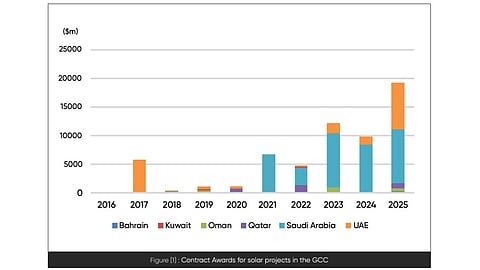
More than $19 billion in new solar contracts were awarded across the GCC in 2025, driven mainly by large utility-scale projects in Saudi Arabia, the UAE, and Egypt
Utility-scale battery storage is set to grow sharply, with BESS capacity expected to rise from under 3 GW today to over 29 GW by 2030, supported by major solar-plus-storage projects
The Middle East and North Africa (MENA) solar PV market is showing signs of maturity, with solar power becoming an integral part of national infrastructure and energy policy, according to the latest report from the Middle East Solar Industry Association (MESIA).
It points to a strong investment cycle, with more than $19 billion in new solar contracts awarded across the Gulf Cooperation Council (GCC) in 2025, mainly driven by utility-scale projects in Saudi Arabia, the UAE, and Egypt.
In its Solar Outlook Report 2026, MESIA points out that while the global solar additions are projected to plateau for the 1st time in 2 decades, MENA will move in the opposite direction as it transitions from 'ambition-led growth to enforceable delivery at scale'.
“The story of solar in MENA is no longer about catching up,” said Executive Director at MESIA, Hinde Liepmannsohn. “It is about setting the terms of what a renewable-dominant energy system looks like in some of the world’s most demanding operating conditions.”
A sign of market maturity is that solar is no longer planned in isolation, but it is being integrated with storage, advanced forecasting, and grid intelligence, added Liepmannsohn.
The report writers forecast that the region’s utility-scale battery energy storage system (BESS) capacity will expand from under 3 GW today to exceed 29 GW by 2030, thanks to ‘record-breaking solar-plus-storage projects’.
Going forward, solar’s advancement will be determined by grid readiness, storage deployment, and digital intelligence, rather than generation capacity alone.
The report can be downloaded for free on MESIA’s website.
