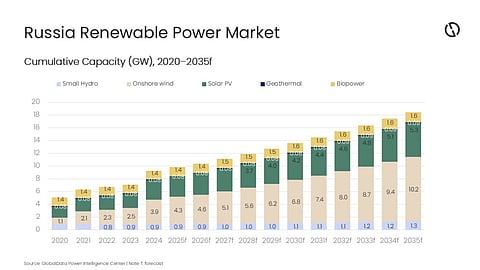


Russia’s cumulative installed renewable energy capacity reached 9.8 GW by the end of 2025, according to GlobalData
It is expected to grow to 18.4 GW by 2035, reflecting a CAGR of about 6.5% over the decade
Onshore wind will drive most of the growth, while solar PV will follow next, with additional contributions from small hydro, geothermal, and biopower
Renewables expansion is supported by the CSA framework, while localization rules in auctions are also supporting domestic turbine and solar module manufacturing
Gas and nuclear will continue to anchor the country’s power system over the forecast period, adds GlobalData
At the end of 2025, Russia’s cumulative installed renewable energy capacity had reached 9.8 GW, according to GlobalData, which expects it to further expand to 18.4 GW by 2035. This expansion, driven by onshore wind and solar PV, will entail a compound annual growth rate (CAGR) of close to 6.5% between 2025 and 2035.
Onshore wind will be the pillar of this growth as it is projected to expand from 4.3 GW in 2025 to 10.2 GW in 2035. Over the same period, utility-scale solar will lead solar PV’s expansion from 3.1 GW to 5.3 GW. The remaining capacity will come from small hydro, geothermal, and biopower.
These renewable energy sources are advancing in Russia under structured state-backed mechanisms rather than merchant market dynamics, according to the analysts.
In its new report on the Russian power market, GlobalData Power Analyst Mohammed Ziauddin observes, “Wind and solar projects are supported through long-term capacity payments and localization requirements, which provide investment stability while strengthening domestic manufacturing.”
GlobalData cites the Capacity Supply Agreement (CSA) framework as the major driving factor for wind and solar’s expansion in the country. Under this framework, select wind and solar projects get fixed capacity payments for up to 15 years within the Wholesale Electricity and Capacity Market. On one hand, this protects the projects from electricity price changes; on the other, developers gain stable, predictable income.
Russia’s mandate to ensure the use of locally made equipment as part of auctions has also encouraged the growth of domestic wind turbine assembly and solar module manufacturing, it adds.
Renewable expansion is strongest in southern Russia, the Volga region, and some eastern areas, where solar and wind resources are good, and grid infrastructure is suitable, the report notes.
Yet, wind and solar are complementary energy sources in Russia and are likely to remain so, as the country continues to rely on conventional and nuclear power for its baseload power supply. Among thermals, it is the country’s natural gas capacity that’s forecast to expand from 14.3 GW in 2025 to approximately 151.2 GW over the next decade. Nuclear power capacity will also grow from 26.8 GW to 28.6 GW over the forecast period.
“Over the next decade, Russia’s renewable focus will center on the phased rollout of CSA RES 2.0 auctions and the fulfillment of stricter localization requirements, particularly for wind and utility scale solar. Capacity additions will remain structured, and volume controlled, with priority given to domestic manufacturing development and selected regional deployment,” adds Ziauddin.
According to the Russian Association for the Development of Renewable Energy (ARVE), the country’s total installed renewable energy capacity stood at 7.21 GW as of January 1, 2026.
