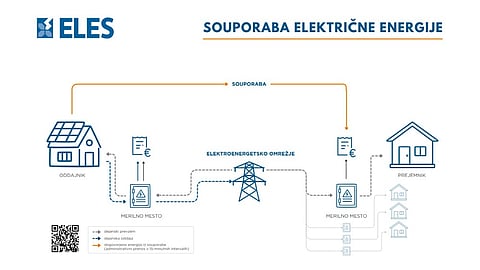


Slovenia plans to launch an electricity sharing system from July 1, 2026, with registrations opening on June 1, 2026
Rooftop solar system owners will be able to transfer surplus electricity to users anywhere in the country
Sharing will be calculated in 15-minute billing intervals and reflected on electricity bills as an administrative transfer
Slovenia is set to introduce a nationwide electricity-sharing system from July 1, 2026, enabling households with renewable energy systems, such as rooftop solar plants, to transfer surplus electricity to other users. Registration for the system will open on June 1 through the Moj Elektro portal.
The new framework is being introduced through amendments to the country’s Electricity Supply Act (ZOEE), and will be managed by the country’s state-owned electricity transmission company, Elektro-Slovenija, d.o.o. (ELES).
It aims to improve the use of surplus electricity from large solar power plants by enabling it to be shared with others, helping balance the grid while also providing social benefits.
Under the scheme, users generating excess electricity from their renewable energy systems will be able to share or sell it to one or more recipients through formal agreements. For this arrangement to work, recipients do not need to live nearby, as electricity can be shared anywhere within Slovenia.
The system will operate in 15-minute billing intervals. During each interval, the sender can allocate a defined share of surplus electricity to recipients. These allocations can be adjusted monthly through the portal.
According to the announcement, the measure is intended to improve the use of renewable electricity during periods of high solar generation while also supporting a ‘solidarity effect’ by enabling users to help relatives, friends or acquaintances.
“The price agreement depends entirely on the ‘seller’ (transmitter) and the ‘buyer’ (receiver),” says ELES in a statement, adding that electricity could also be transferred to the recipient at a symbolic price.
The transferred electricity will not physically flow through the grid to the recipient. Instead, it will be treated as an administrative transfer and reflected in electricity bills issued by suppliers. The system will affect only the electricity component of bills, not network charges, except for customers using annual net metering.
Consumers under Slovenia’s annual net metering system will only be allowed to act as energy transmitters, not recipients. For instance, a self-sufficient solar producer is sending 9,000 kWh of electricity to the grid while consuming 7,000 kWh from it during a billing period. If 1,000 kWh is shared with another user, the producer would still retain a 1,000 kWh surplus in the final billing calculation.
For large companies and businesses, electricity sharing would qualify as an economic activity and, as such, they will not be eligible to participate.
Renewable energy accounts for about 40% of Slovenia’s current electricity mix, 90% of which comes from hydropower, while thermal power plants account for 23% of electricity production. At the end of 2025, Slovenia’s total installed solar PV capacity had reached 1.568 GW, up from 1.42 GW in 2024, as per the International Renewable Energy Agency (IRENA).
According to the US International Trade Administration (ITA), almost half of the country’s total energy consumption comprises imported petroleum. By 2033, Slovenia aims to phase out coal.
The country is also preparing a new Comprehensive National Energy and Climate Plan (NECP) for 2030-2040 to be submitted to the European Commission by January 1, 2028. The final version will need to be adopted and notified by January 1, 2029. It will be aligned with the EU target to achieve 90% reduction in net emissions by 2040 compared to 1990, and the national commitment to become climate neutral by 2045.
