

Electric homes with solar, batteries and EVs could save Kiwi households about NZD 3,000 per year after financing costs, or NZD 45,000 over 15 years, says a new report
If 80% of New Zealand homes installed 9 kW solar systems and 10 kWh batteries, they would add 14.8 GW of rooftop solar capacity, and provide 8.2 GW of peak battery power
Wider electrification could deliver NZD 12.9 billion in annual national energy bill savings, create about 58,000 jobs, and strengthen New Zealand's energy security
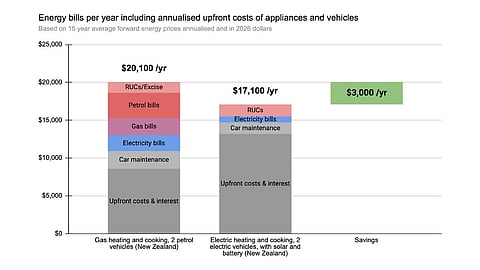
A new report from Rewiring Aotearoa says New Zealand households could save around NZD 3,000 annually by switching to electric appliances, electric vehicles (EVs), rooftop solar, and battery storage, even after accounting for upfront costs and loan repayments.
In the Electric Homes and Vehicles 2026 report, Rewiring Aotearoa analysts highlight that the financial advantage of fully electric homes over those that rely on gas and petrol has doubled in Aotearoa (the Māori-language name for New Zealand) since 2024.
They attribute this to rising prices for grid electricity, gas and transport fuels, alongside falling costs for solar panels, batteries, EVs, and other electric technologies.
The report estimates that an average household could reduce its annual energy bills by about NZD 7,600 before financing costs if it chooses electrified appliances over gas, electric over petrol vehicles, and a solar and battery system. After including upfront investment and loan interest, the net annual savings are around NZD 3,000, or a net NZD 45,000 over 15 years.
To reflect long-term trends, the study excluded the sharp fuel price increases seen in 2026 due to the war in the Middle East, taking a ‘pretty conservative’ approach. “The numbers stacked up before the war, but the gap would be even bigger this year due to the fuel price spikes,” said Rewiring Aotearoa CEO Mike Casey.
Casey said the findings show electrification delivers benefits beyond individual households. “Homes save thousands every year. Communities save millions. The country saves billions – all while increasing productivity, improving energy security and slashing emissions,” he added.
It also highlights the broader energy system benefits of rooftop solar and battery storage. If 80% of New Zealand homes adopted 9 kW solar and 10 kWh batteries, argue the analysts, they could generate around 46% more electricity, nearly doubling the country's current hydroelectric output. Rooftop solar capacity from such systems would total 14.8 GW, representing annual generation capacity of 20,000 GWh, while the batteries would provide 8.2 GW of peak power, about 6 times the instantaneous output of the 1.2 GW Huntly power station, the biggest in the country today.
The report also states that electric technologies are significantly more energy-efficient than fossil-fuel alternatives. Electric heat pumps are estimated to be 2 to 4 times more efficient than gas heating systems, induction cooktops 2 to 3 times more efficient than gas cooktops, and EVs 2 to 4 times more efficient than petrol or diesel vehicles.
At the community level, the report estimates that electrifying 10,000 homes could generate NZD 66 million in annual bill savings and NZD 320 million in net savings over 15 years. Nationally, annual energy bill savings could reach NZD 12.9 billion, while cumulative net savings could total NZD 61 billion by 2040.
Independent Economist Cameron Bagrie, who peer-reviewed the report, said electrification could help lower household energy costs while improving New Zealand's long-term economic productivity and energy security. “We have passed a key inflection point, where the economics of solar have become compelling. Households represent the country's largest energy-consuming sector, and shifting that consumption onto domestically generated renewable electricity reduces the import bill, keeps spending within the New Zealand economy, and delivers further savings through the inherent efficiency of electric machines,” according to Bagrie.
The report estimates that increased deployment of heat pumps, rooftop solar systems, and EV chargers could create around 58,000 jobs.
It also says wider household electrification could cut New Zealand's reliance on imported fossil fuels by about half and reduce carbon emissions by around 10 million tons. However, the report writers highlight that high upfront costs remain a major barrier, particularly for low-income households and renters. They call for improved financing options and policy measures to make electrification more accessible.
The complete report is available for free download on Rewiring Aotearoa’s website.
