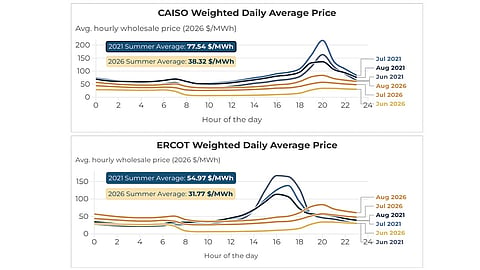


Wholesale power prices dropped 51% in California and 42% in Texas between the summers of 2021 and 2026, even as electricity demand increased in both states
Reduced wholesale electricity costs saved an estimated $2.5 billion in California and $3.55 billion in Texas, as solar generation and battery storage expanded
Despite lower generation costs, rising transmission and distribution expenses have pushed up consumer bills in both states
Wholesale electricity prices fell sharply in California and Texas between the summers of 2021 and 2026, despite rising power demand, according to a new analysis by the Solar Energy Industries Association (SEIA). The analysis shows how combining solar and storage has helped lower wholesale electricity prices in Republican and Democrat states alike.
Average wholesale prices in summer months (June-August) decreased 51% in California (CAISO), from $77.54/MWh to $38.32/MWh. Texas (ERCOT) wholesale electricity prices fell 42% during the same months, from $54.97/MWh to $31.77/MWh.
SEIA says much of this price decline comes from rapid growth in solar generation and battery storage, which increasingly replace expensive peaker plants and set market-clearing electricity prices.
Solar generation in the state increased 90% from 2021 to 2026, while its battery storage capacity grew from 8.1 GWh to 62.0 GWh, accounting for about 6-7% of daily energy use. The analysis finds that wholesale prices were much lower, even as summer 2026 electricity demand was 2.5% higher than in 2021.
With average summer peak prices falling from $141.75/MWh to $59.69/MWh over the five-year period, Californians are estimated to have saved $2.5 billion, thanks to reduced wholesale electricity costs.
On the retail side, while the state’s generation costs decreased 10%, total bills rose as transmission costs increased 12%, distribution costs rose 51%, and other costs (including wildfire-related expenses) rose 90%.
The state’s solar generation more than quadrupled from 2021 to 2026, and its battery storage capacity grew from 1.0 GWh to 33.1 GWh. Although summer electricity consumption rose 30.1%, wholesale prices still fell significantly.
With average summer peak prices falling from $110.96/MWh to $57.30/MWh, these lower wholesale power prices are estimated to have saved Texas citizens $ 3.55 billion. However, their bills have increased over the five-year period. While generation costs fell 4% and other costs fell 5%, transmission costs rose 17% and distribution costs rose 23%, driving up bills for the end consumer.
Over the five years, both states saw rooftop solar generation increase, though to varying degrees. In California, rooftop solar generation rose by more than 4,000 GWh, increasing net generation by 11%. In Texas, rooftop solar generation increased by 970 GWh, raising net generation by 0.5%.
The analysis says rooftop solar and batteries at customer sites help relieve grid stress and reduce the need for additional centralized generation resources. Recall that SEIA expects US solar additions to remain largely flat through 2031 (see SEIA: US Solar Installations Fall 27% YoY To 7.8 GW In Q1 2026).
Rapid deployment of solar and battery storage has substantially reduced wholesale electricity prices in both California and Texas, producing billions of dollars in savings even as electricity demand increased, says the report.
SEIA CEO Tim Pawlenty said, “As the midterm elections approach, delivering affordable, reliable power is a priority that transcends party lines and Texas and California are proof that the growth of solar and storage is driving down prices.”
The report concludes that despite these declines in wholesale prices, rising transmission and distribution costs continue to put upward pressure on customer utility bills.
