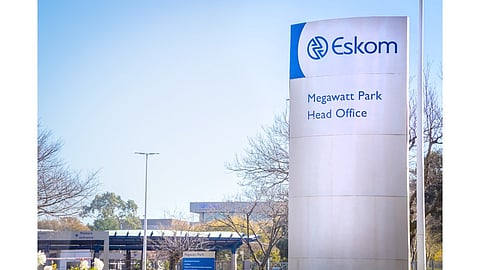


Eskom has launched Eskom Green as a dedicated utility-scale renewable energy business
The company plans to provide around 6 GW of renewable and storage capacity by 2030 in the initial phase
Its initial focus will be large industrial customers, with broader market expansion planned for later
South African utility Eskom Holdings has launched a dedicated renewable energy business under a new wholly-owned ‘ring-fenced’ subsidiary called Eskom Green.
It has been designed in response to global benchmarking research on over 20 utilities, it explained. Eskom added, “This approach is consistent with international best practice, where state-owned utilities have established dedicated renewable platforms to scale up delivery while managing balance-sheet, governance, and market-participation risks.”
A dedicated renewable energy business Eskom Green will accelerate utility-scale clean energy development with an aim to support major power users reduce their carbon emissions.
The new division will focus on supplying renewable electricity to industrial customers, particularly in the mining and manufacturing sectors, through a combination of solar PV, battery energy storage systems (BESS), wind and pumped storage projects. Customers will commit to fixed energy volumes under take-or-pay agreements, supporting project financing.
Later, Eskom Green will expand services to the Eskom distribution market, municipalities, the South African wholesale electricity market, and the Southern African Power Pool (SAPP).
According to Eskom, Eskom Green’s business model is designed to offer customers transparent pricing and long-term renewable energy supply agreements. It will support around-the-clock electricity delivery through storage and other firming solutions.
Under South Africa’s Integrated Resource Plan (IRP) of 2019, only about 50% of the awarded renewable energy capacity with grid allocation and power offtake agreements have been built.
Eskom Green’s mandate is to work alongside private developers to help close the capacity gap identified in IRP 2025, which targets 5.6 GW of renewable energy by 2030, 21 GW by 2035, and 32 GW by 2040. The plan also estimates that every 10 GW of renewables will require 6 GW of dispatchable power capacity.
Eskom Green plans to make around 6 GW of renewable energy capacity available by 2030, supported by 17 priority projects across Eskom’s existing coal power station sites. This includes at least 2 GW of renewable energy and pumped storage projects expected to advance from 2026, including the 75 MW Lethabo solar PV project in the Free State. It launched construction of Lethabo project in May 2026.
“By strengthening coordination across the sector, South Africa’s energy supply can be collectively secured, emissions reduction targets can be advanced, and the large-scale, rapid decarbonisation solutions can be delivered urgently as required by industrial customers,” stated Eskom.
While the initial projects under Eskom Green will be funded through Eskom’s capital program, it will use public-private partnerships and project-specific financing structures for future developments to limit reliance on Eskom’s balance sheet.
Eskom Green will initially operate within Eskom Holdings, but is expected to become a separate wholly owned subsidiary with an independent board, subject to regulatory and governance approvals.
