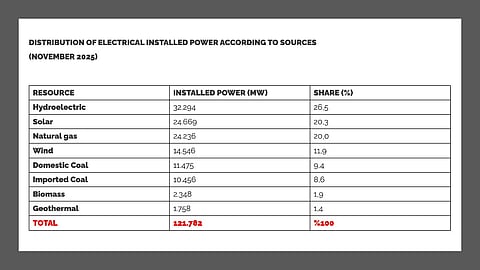


Solar power rose to 24.67 GW in Türkiye’s total power generation capacity at the end of November 2025, edging past natural gas at 24.24 GW
Solar and wind together exceeded 39.2 GW, accounting for about 1/3rd of Türkiye’s installed electricity capacity
Its total installed power capacity reached 122 GW, with renewables at 75.6 GW
Solar energy just beat natural gas to become the 2nd largest power generation source in Türkiye after hydropower, according to the Ministry of Energy and Natural Resources. At the end of November 2025, the installed solar capacity reached 24.67 GW, ahead of 24.24 GW for natural gas.
Hydroelectric remains the largest energy source in the country’s power mix, with a 26.5% share and 32.3 GW installed capacity. Solar now follows next with a share of 20.3%, and natural gas 20%. Wind energy’s 14.5 GW expanded its total share to 11.9%.
Together, solar and wind energy installed capacity in Türkiye exceeded 39.2 GW at the end of November 2025. The share of domestic coal (11.5 GW) and imported coal (10.4 GW) stood at 9.4% and 8.6%, respectively, while biomass (2.35 GW) and geothermal (1.76 GW) contributed 1.9% and 1.4% to the mix, in that order.
Altogether, the country’s total installed electricity capacity reached 122 GW at the end of the reporting period, with renewables accounting for 75.6 GW or 62% of the total.
“Only the share of the sun in our electricity installed power exceeded the 20 percent band and reached 20.3 percent. The share of the wind also increased to 11.9 percent. Thus, 1/3 of our installed power consists of only wind and sun,” said Minister of Energy and Natural Resources Alparslan Bayraktar.
He said Türkiye is committed to further expand the share of renewable energy through the country’s flagship Yenilenebilir Enerji Kaynak Alanları (YEKA) or Renewable Energy Resource Area auctions. In 2025, it awarded 3.8 GW solar and wind energy capacity under the YEKA mechanism, representing an investment of $4 billion, as it targets a 120 GW combined capacity for these renewable energy sources by 2035.
“We have a significant potential especially in solar and wind energy. We will continue to hold a YEKA competition of at least 2 thousand megawatts in this field every year. We will continue to add strength to our strength in renewable energy,” added Bayraktar.
