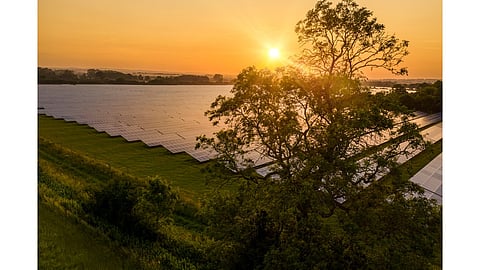


The One Earth Solar Farm, approved by the UK government as an NSIP, could generate enough electricity for more than 200,000 homes each year
It is the 30th nationally significant clean energy project approved by the UK government since July 2024
The approval comes alongside planning reforms aimed at accelerating major clean energy projects
The UK Government has cleared the Development Consent Order (DCO) for a 740 MW solar power plant, calling it the country’s second largest solar farm. A Nationally Significant Infrastructure Project (NSIP), it could power more than 200,000 homes a year.
It follows the April 2026 approval of the country’s largest planned solar PV project in Lincolnshire, with an 800 MW capacity (see UK Approves Country’s Largest Solar Project At 800 MW).
The decision also follows approvals for the Peartree Hill and Dean Moor solar farms last week. While Peartree Hill in Yorkshire is proposed to install 320 MW of solar capacity, Dean Moor Solar Farm will generate close to 150 MW. The latter is being executed by a joint venture between ib vogt and Firma Energy.
Once planning conditions are met, respective developers can move ahead with construction.
The One Earth Solar Farm, to be co-located with a battery energy storage system (BESS), is planned to be located at the border between Nottinghamshire and Lincolnshire. It is a joint development effort between PS Renewables and Perigus Energy. The latter comprises Orsted’s European onshore business that was acquired by Copenhagen Infrastructure Partners in May 2026 and launched as Perigus Energy.
One Earth Solar Farm is now the 30th nationally significant clean energy project approved since July 2024 and the 42nd nationally significant project approved during the current Parliament. It can generate clean electricity to power the equivalent of more than 19 million homes. Approvals for all these projects are aimed at boosting homegrown energy and protecting British people from volatile fossil fuel markets following conflict in the Middle East, the Department for Energy Security and Net Zero stated.
“The only way to have energy security is if we take a pro-growth approach to building more clean energy in Britain. For 2 years that is exactly what this government has done,” said the UK’s Energy Secretary Ed Miliband.
The government recently announced planning reforms that could cut up to 12 months from the approval process for major infrastructure projects in Britain, saving developers around £1 billion. The reforms come into effect from July 24, 2026 (see Britain Cuts NSIP Planning Process By Up To 12 Months).
This was close on the heels of the UK’s plans to introduce long-term fixed-price contracts for renewable energy as it attempts to break the link between gas and electricity prices by increasing the role of renewables in the power mix (see UK To Break Gas-Power Price Link With More Renewables).
The government is also tapping solar power wherever possible, including plans to roll out plug-in solar in UK stores and incorporating solar as a standard for all new homes in England (see UK Turns To Plug-In Solar Amid Middle East Crisis).
