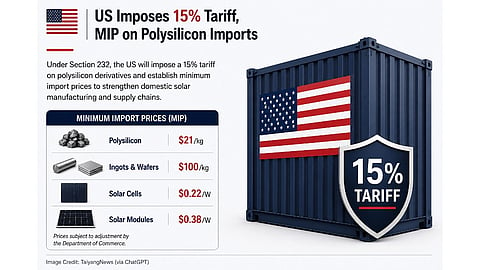


The US will impose a 15% tariff on imported polysilicon from December 4, 2026, following a national security review of imports under Section 232
The new trade measures also include minimum import prices on polysilicon products entering the US
According to The White House, the policy also creates an incentive framework for companies investing in US polysilicon and solar manufacturing facilities
The much-awaited US Section 232 decision on polysilicon imports is now out. The proclamation imposes a 15% tariff on imported polysilicon derivatives and establishes a minimum import price (MIP) program for polysilicon and specified downstream products.
President Donald Trump signed the proclamation on August 6, 2026, and the measures will take effect on December 4, 2026. The 15% tariff on downstream derivatives replaces a narrower safeguard tariff on imported solar cells and modules that expired in February 2026.
Trump signed the proclamation following a Department of Commerce (DOC) report into the national security review it launched last year into polysilicon imports under Section 232 of the Trade Expansion Act of 1962. Wood Mackenzie had warned that this investigation would be the ‘biggest supply chain challenge’ for the US solar industry, stalling its growth and domestic manufacturing plans (see Wood Mackenzie Calls Section 232 US Solar’s Biggest Challenge).
According to the DOC report, imports have weakened US polysilicon production, with the country’s share of global manufacturing capacity falling from 50% in 2025 to less than 2% in 2024, while the country remains highly dependent on imported solar ingots, wafers and cells. While the proclamation doesn’t specify any country, China produced 93.5% of global polysilicon in 2024, according to Bernreuter Research (see China Dominates 2024 Global Polysilicon Production).
The country’s dependence on imported polysilicon and its derivatives raises concerns over the long-term viability of the US supply chain since semiconductor-grade polysilicon is also required for defense and artificial intelligence (AI) applications, says the US.
Along with the 15% tariff, the proclamation also establishes the MIP program, setting a price floor for imported polysilicon and polysilicon derivatives. Under this, imported polysilicon will be subject to a minimum price of $21/kg, polysilicon ingots and wafers $100/kg, solar cells $0.22/W, and solar modules $0.38/W. The DOC can adjust the MIPs from time to time.
Importers that fail to provide required documentation to the US Customs and Border Protection (CBP), or whose declared values fall below the minimum levels, will face additional duties based on the difference. Lack of proper documentation may lead to a tariff equal to the applicable MIP, while false declaration could lead to a permanent import ban and penalties.
This will likely raise imported module prices, benefiting domestic solar module manufacturers. According to InfoLink Consulting, US-assembled solar module prices currently range from $0.30/W to $0.33/W.
The White House says this will create a ‘level playing field’ for American manufacturers.
Companies with approved onshoring plans may qualify for tariff relief on eligible imports used during the construction of new or expanded manufacturing facilities, subject to compliance with investment commitments. Approved projects must begin construction by January 20, 2029.
The proclamation also authorizes the Secretary of Commerce to establish an incentive program for companies that invest in producing polysilicon, ingots, wafers, and solar cells in the US. As of June 2026, the US had 70 GW of operational solar module production capacity, but only 3.2 GW of cell capacity. SEIA had earlier said that the Section 232 trade action on solar-grade polysilicon and derivative products could severely constrain manufacturing activity for some domestic producers.
The White House said the measures are intended to create ‘a commercially viable market’ for US producers and encourage investment in domestic manufacturing.
Previous measures targeted manufacturing locations of cells and modules, which – in addition to impacting foreign manufacturers – kept changing. Very recently, the DOC initiated a circumvention investigation into solar cell and module imports from Ethiopia. This time, it is the building block of solar cells that’s hit.
“For decades, American solar manufacturers were forced to spend tens of millions of dollars on trade lawyers to fight predatory Chinese trade case by case through the AD/CVD laws — an endless game of whack-a-mole in which the imports simply moved to the next country, the cases never ended, and the fees never stopped. This proclamation changes that,” said Coalition for a Prosperous America (CPA).
CPA President Jon Toomey stressed that this will protect the entire solar supply chain with a single action while rewarding manufacturers to build locally.
Ahead of the December 4 deadline, the US may see heightened activity in polysilicon/cell imports as companies review their project timelines and purchasing strategies, but long-term, industry observers believe it will be a meaningful development for the US solar industry, encouraging vertical integration faster than the current pace.
This hybrid system should be a positive for US manufacturers of polysilicon, including Hemlock Semiconductor and Wacker Chemie, along with local module players such as First Solar that doesn’t depend on silicon for its CdTe modules, and T1 Energy that has contracted US suppliers (see T1 Energy Locks In US-Produced Silicon Wafer Supply With Corning).
Germany’s Wacker Chemie, which operates a hyperpure silicon facility in Charleston, Tennessee, had been waiting for a positive Section 232 announcement for its solar-grade polysilicon business to pick up (see Wacker Chemie Sales Fall 4% In 2025; Announces 1,500 Job Cuts).
