

Wood Mackenzie says $121 billion of renewable investment linked to 92 GW of utility-scale projects is at risk, with projects facing higher permitting scrutiny in the US
Solar has the largest project exposure, while wind faces the highest proportional permitting risk
Analysts believe court action and the proposed SPEED Act could help simplify federal permitting if reforms move forward
More than $121 billion in renewable energy investment could be at risk in the US as expanded federal permitting oversight places 92 GW of utility-scale projects under increased scrutiny, according to a new Wood Mackenzie report.
The report identifies 12 GW of exposed capacity on federal lands and 80 GW on private lands. It adds that permitting changes and reduced federal funding have already contributed to 7 GW of project cancellations or inactivity in 2025.
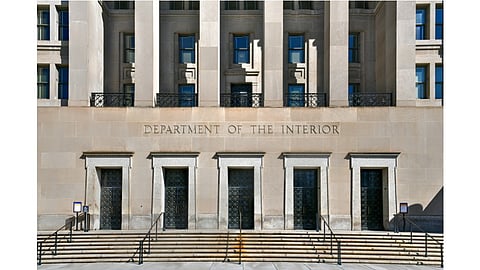
It refers to the new multi-step approval system, introduced by the US Department of the Interior (DOI) on July 15, 2025. This has increased permitting scrutiny for projects involving federal agencies and extended approval timelines for most wind and solar projects (see Elevated US Federal Scrutiny For Wind & Solar Energy Projects).
In its report, Federal friction: permitting risk across the US utility-scale renewables pipeline, Wood Mackenzie says solar has the ‘largest absolute exposure’, with 30% of its development pipeline potentially subject to additional review. Wind faces the highest proportional exposure, with 62% of its pipeline affected, excluding the ongoing halt related to the Federal Aviation Administration (FAA).
More than a quarter of planned energy storage capacity is also exposed to increased permitting scrutiny. According to an American Clean Power Association (ACP) report, the US had a clean power capacity backlog of 53 GW as of the end of Q1 2026 (see Solar & Storage Lead Q1 2026 US Clean Power Additions).
The Wood Mackenzie report notes that 32% of the early-stage renewable pipeline, including announced, in development, and permitted projects, is now subject to additional federal review. Projects planned for 2029 face the greatest risk on federal lands, potentially affecting their eligibility for tax credits. Texas has the highest exposure, followed by California and Arizona.
According to Kaitlin Fung, Senior Research Analyst at Wood Mackenzie, although many early-stage renewable projects have been delayed or cancelled since 2025, permitting is only one factor. Supply chain challenges and tighter financing are also contributing factors.
Permitting risks also differ across technologies. Wetlands remain the main permitting challenge for solar, wind, and storage projects, particularly on private land in Oregon, Alabama, Maine, Minnesota, and Montana, while wind projects face additional constraints related to airspace approvals.
Wood Mackenzie also points to recent policy developments that could ease some of the pressure. In April 2026, Chief US District Judge Denise Casper issued a preliminary injunction halting the DOI and other agencies from further delaying the deployment of wind and solar energy projects (see US Court Halts Delays To Wind & Solar Project Rollout).
Meanwhile, the proposed Simplifying Permitting and Ending Endless Delays (SPEED) Act aims to streamline environmental reviews, reduce duplication across agencies, and set stricter permitting timelines. It awaits Senate and executive approval. However, solar and wind industry bodies believe the bill does not ensure fair, predictable permitting for renewables (see US’ SPEED Act Fails To Impress Clean Energy Industry).
Gaby Ackermann Logan, Research Associate at Wood Mackenzie, said permitting remains one of the biggest barriers to new renewable projects. She added that uncertainty is particularly challenging for energy storage, which is often developed alongside solar, making predictable permitting processes essential for keeping projects on schedule and financially viable.
“The policy landscape is shifting quickly, and developers who can anticipate where the friction points are will be better positioned to protect their timelines and maintain project bankability,” added Ackermann Logan.
