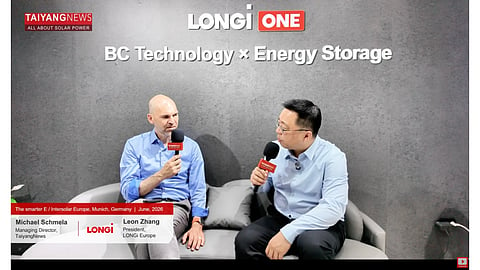


The European solar market is moving more toward utility-scale projects and integrated energy solutions. Module technologies and business models are also evolving in step with this shift.
In an interview with TaiyangNews Managing Director Michael Schmela at Intersolar Europe 2026, Leon Zhang, President of LONGi Europe, spoke in detail about the company's response to these market trends, its back-contact technology, and integrated PV-plus-storage solutions.
TaiyangNews: LONGi has long been a leader in solar modules and cells, and has also expanded into energy storage. Europe has traditionally been a strong residential market, but the utility-scale segment is growing. How is LONGi positioning itself in this changing market?
Leon Zhang: In my view, the overall European market is more or less flat when residential, commercial & industrial (C&I), and utility-scale segments are all considered together. At LONGi, however, we are seeing strong growth in Europe. In 2025, we shipped around 16 GW in Europe alone, our highest annual shipment in the region, giving us an average market share of close to 25%.
Our strategy is also evolving from volume-centric to partnership-centric. Customers are not looking for a single project; they expect long-term partnerships that help them grow their business. We therefore focus on long-term partnerships, work selectively with customers, and emphasize solutions that are driven by the levelized cost of electricity (LCOE).
At the same time, we continue to expand our product portfolio across PV modules, battery energy storage systems (BESS), and electrolyzers. This year, we introduced new products in all 3 areas and are increasingly integrating these technologies. That is also the reason why we introduced OneBank 2.0. It combines PV and BESS in response to the growing demand in Europe for integrated PV-plus-storage systems.
TaiyangNews: LONGi has been advancing back-contact (BC) technology for several years. Initially, BC modules were primarily associated with the residential market thanks to their high efficiency and aesthetics. Can this technology compete in the utility-scale segment? Could you share your experience of introducing BC technology in this market?
Leon Zhang: BC technology is well suited to the current utility-scale market. Power purchase agreement (PPA) prices and contracts for difference (CfDs) are declining, so developers need higher energy yields from limited land to safeguard internal rates of return (IRRs).
In countries such as France, where land is limited, but the grid is not heavily congested, developers can install more capacity on the same land. From an LCOE perspective, BC technology is therefore becoming a natural choice for many customers.
This is reflected in our orders. In 2025, BC modules accounted for around 30% of our utility-scale orders. In the first 6 months of this year, the percentage increased to around 70%. More independent power producers (IPPs), investment funds, and engineering, procurement, and construction (EPC) companies are choosing BC technology.
At the same time, the technology continues to evolve. At Intersolar Europe 2026, we introduced BC Prime, with up to 680 W power output and 25.2% module efficiency. We continue to introduce new variants as the technology develops. To date, LONGi has shipped 60 GW of its first- and second-generation BC products worldwide.
TaiyangNews: It’s really interesting to see BC evolving. Traditionally, TOPCon has been considered to have a lower LCOE due to higher bifaciality. What brings about BC’s success from an LCOE perspective?
Leon Zhang: If we compare BC and TOPCon modules of the same size, BC delivers 10-15 W higher power than TOPCon. This provides a natural advantage where land availability is limited. The second advantage is reliability. BC uses TaiRay, LONGi's proprietary wafer technology. TaiRay is the fundamental wafer technology that enables LONGi's BC technology and is robust enough to help prevent microcracks.
When all BC parameters are included in the financial model, LCOE is naturally reduced. For example, our latest module Hi-MO 9 Prime delivers an additional 10 W compared with the standard Hi-MO 9.
TaiyangNews: How do you see the market outlook and the further evolution of module technology, and how does that reflect what you've seen here at the show?
Leon Zhang: Technology-wise, manufacturers are adopting BC. Different companies use different names, but the number of players entering the BC segment continues to grow. Compared with TOPCon, BC also has an advantage as silver prices increase. Further improvements in TOPCon largely depend on higher silver consumption, whereas BC has multiple alternative approaches to achieve similar results. Over the next 6 to 12 months, both the number of BC manufacturers and market adoption are expected to continue growing. We are also converting more of our production capacity from TOPCon to BC. At the same time, LONGi will continue to offer both TOPCon and BC products.
TaiyangNews: How is the market responding to your integrated PV-plus-storage solution offerings showcased at Intersolar Europe?
Leon Zhang: We are not starting from scratch in energy storage. We acquired PotisEdge in November 2025 and quickly integrated its expertise into LONGi, rebranding it as LONGi Storage.
After this, we introduced the OneBank series, an AC-coupled solution for co-located PV and battery energy storage projects. Our focus is on co-located projects that combine modules and BESS. With OneBank 2.0, customers can achieve several advantages.
We are focusing on this combination because the business case is changing. Negative PPAs and electricity prices are becoming more common. From an IRR perspective, solar-only projects have become less viable. The stronger business case comes from co-located PV-plus-BESS projects, and we are seeing this trend across the UK, Germany, Spain, and other markets.
Our solution combines Hi-MO 9 with the OneBank solution to provide an answer for our customers. We call it an all-in-one strategy, offering ‘one platform’, ‘one system’, and ‘one responsibility’.
This is an edited version of the transcript. The full interview can be watched here.
