
Back-contact (BC) technology has quickly become one of the most closely watched developments in the residential solar market, with manufacturers pursuing higher efficiency alongside improved aesthetics.
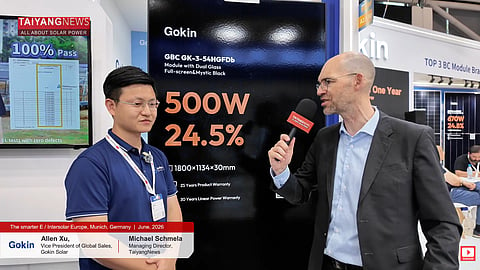
In an interview with TaiyangNews Managing Director Michael Schmela at Intersolar Europe 2026, Allen Xu, Vice President of Sales at Gokin Solar, elaborated on the company's transition from wafers to modules, its collaboration with AIKO, and its expansion strategy beyond China. Here is an edited version of the interview.
TaiyangNews: Tell us a little about Gokin and its overseas activities.
Allen Xu: Gokin Solar was established 5 years ago, starting with the silicon solar wafer business, holding as much as 15% of the global market share. Last year, the company shipped over 90 GW of wafers, roughly equivalent to 1 in 7 modules using Gokin’s wafers. We entered the module business 3 years ago and entered the European market 2 years ago. We currently serve customers in over 40 regions and countries and are the third company to mass-produce modules using back-contact (BC) technology.
TaiyangNews: BC modules are a hot topic in Europe, given their high efficiency and aesthetics. What made Gokin pursue the BC route and what's your strategy there?
Allen Xu: Gokin’s history with BC technology dates back to roughly 2022, when AIKO wanted to add module manufacturing capabilities beyond being a pure ABC cell manufacturer. AIKO was looking for a supplier for wafers of a specific size. Gokin stepped in to work with them on customizing silicon wafers for BC.
AIKO consulted with us again 2 years later to collaborate on building an ecosystem. We shared some of the patents and the IPs, and AIKO helped us build up the production lines.
Initially, we had 2 production lines producing first-generation products. These modules had gaps between the cells. In 2026, we invested in 2 new lines, which we can call the second generation. These lines produce modules with no gaps between the cells. Also, the busbars are hidden on the rear side. We call it the Full-Screen All-Black module.
While the Gen 1 product had busbars in the middle, top, and bottom, the Gen 2 product utilizes roughly 97% of the module area, increasing the overall maximum power to 500 W, up from 485 W in the first generation.
Additionally, we researched and customized a glass for this product for all kinds of scenarios. The glass used in our modules for rooftop, airport, and runway installations has an anti-glare coating to prevent glare. We are also working on a specific coating that ensures all module surfaces dry uniformly after exposure to rain.
So that's the background of our involvement in BC technology.
TaiyangNews: You started with wafers, then got into modules. What is your general strategy on vertical integration?
Allen Xu: It is common for companies to find positions of strength.
Gokin’s inherent advantage lies in manufacturing products to reduce costs and improve quality. The wafer business is more about manufacturing than marketing. Given that modules have to last 30 years on rooftops or on the ground, apart from higher power outputs, quality and safety are key parameters for modules, too. So we believe our manufacturing strength can help us win this competition.
At the same time, given that we already have 100 GW of wafer supply capacity for cell makers, it would be meaningless for us to compete with our direct customers. However, we can double down on this collaboration by selling our wafers to our customers and buying cells from them. I think it's a very simple choice: we utilize our manufacturing capacity for wafers and collaborate in the module business.
TaiyangNews: What is your expansion strategy and which markets are your highest priorities?
Allen Xu: Gokin is taking one step at a time because we know it is hard to be a newcomer in any market at the moment, not just in Europe, but also in regions like the Middle East, Africa, and Southeast Asia. So, our priority is
the European market, where we aim for the residential segment, as we have the right product for that application, offering high power and aesthetics.
For developing regions such as Southeast Asia and Latin America, we plan to cater with our cost-competitive TOPCon product. This is how we differentiate our product and strategy in different markets.
In the future, we want to be an all-scenario solution provider for modules. We plan to focus beyond the residential segment in several other developed and developing markets. We would like to make our presence in the utility and bigger C&I segments.
TaiyangNews: Sounds like an exciting strategy. Thank you for the interview.
The full interview can be watched on the TaiyangNews YouTube channel here.

