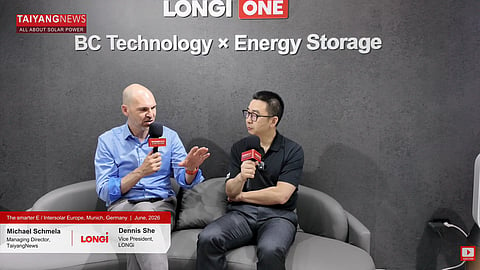

LONGi has established itself as one of the leading technology companies in the solar industry through continuous advances in wafers, cells, and high-efficiency modules. With the launch of LONGi ONE, the company is extending that approach beyond individual PV components to integrated solar-plus-storage solutions. Rather than viewing energy storage as a separate business, LONGi positions it as a natural evolution of utility-scale and commercial PV systems, where optimization increasingly happens at the system level.
In this interview, Dennis She, Vice President of LONGi, discusses the company’s strategy behind entering the storage market, the role of acquisition, its focus on system integration, and why LONGi believes the next stage of the energy transition will be driven by tightly coordinated PV and battery storage systems.
TaiyangNews: LONGi is active across many areas of the solar value chain and has now entered the storage market. Can you provide some background?
Dennis She: Energy storage has become an essential part of the energy transition. The next phase is no longer just about solar but about integrated solar-plus-storage systems. That is why LONGi has entered this space. It is not simply about adding another business line but about customer requirements for a turnkey solution.
Today, many customers still purchase components such as PV, batteries, and power conversion equipment from various suppliers. While the components are connected together, they are not really coordinated. That's a gap we want to address through LONGi ONE.
LONGi ONE integrates the PV generator, battery energy storage system (BESS), and power conversion system (PCS) into one coordinated solution. Rather than focusing on individual components, we optimize the entire system's performance.
At the same time, solar-plus-storage systems are expected to operate for more than 20 years. Reliability and warranty support will be critical to customers, and LONGi believes it has a unique advantage in these areas.
TaiyangNews: LONGi ONE is an integrated solution from a single vendor. How does this strategy differentiate LONGi in an extremely competitive storage market?
Dennis She: As I just mentioned, our objective is to build PV and battery storage as one integrated system rather than assembling separate components afterward.
The objective is very clear: achieve higher system efficiency, better project economics, and greater reliability.
On the BESS side, LONGi has developed strong in-house R&D capabilities. We design and integrate everything except the battery cells. We consider the cell as a standardized component, while the real value lies in battery management, system control, and overall integration.
As the PV system, battery management, and control platform are designed together, they share the same communication protocols, service standards, and operating logic. This creates better coordination across the entire system. We are focused on better integration rather than the individual component level.
TaiyangNews: LONGi has consistently ranked at the top of TaiyangNews TOP MODULES with industry-leading module efficiencies. How does battery storage complement such a strong PV portfolio?
Dennis She: Our goal is to extend the same high-efficiency philosophy from the module level to the entire energy system.
Our latest product is the OneBank 2.0 platform. It is one of the few AC container solutions on the market with integrated in-house PCS and BMS. According to our internal evaluations, it delivers industry-leading round-trip efficiency (RTE). We also developed a platform that supports both AC and DC coupled architectures, enabling hybrid PV plus BESS projects, while maximizing overall system efficiency.
This is where LONGi wants to differentiate itself: developing the highest-efficiency solutions for co-located PV and battery storage systems.
TaiyangNews: LONGi entered the battery storage market relatively recently, but through an acquisition rather than developing everything internally. Can you tell us more about that strategy?
Dennis She: Some people say LONGi entered the storage market late. I don’t think that is true. In the early years, much of the storage market was driven by grid-side applications. Around the beginning of 2025, however, it became increasingly clear that, as renewable penetration continues to rise, particularly after events such as the blackout in Spain, future solar power plants will increasingly be developed as hybrid PV-plus-storage projects.
Then we realized that's something we have to step in for. However, we cannot do everything from scratch. That's why we try to choose a company in the market that has strong in-house R&D capabilities but doesn't have a strong brand, sales, or marketing, and doesn't have good connections or insight into customer needs. That's something LONGi is good at. Then we quickly complete the acquisition and begin developing the new strategy, combining LONGi's unique advantages. We have a better understanding of customers and segments. However, this company, PotisEdge, has very strong capabilities in technology R&D. So, we quickly realized we have a very good roadmap to develop.
So that's something that happened very fast. Because people say we are a little late, the only way to catch up is to run very fast.
TaiyangNews: What products are currently available, and which market segments are you targeting?
Dennis She: Currently, we are focusing on 3 main segments. The first is utility-scale storage, complementing our utility PV business. The second is C&I applications, particularly behind-the-meter.
We introduced a new C&I product in Europe, and the market response on the first day of Intersolar has been very encouraging.
The third segment is off-grid and microgrid applications. In regions with limited grid infrastructure, solar combined with storage provides a highly effective solution. Solar alone is often insufficient, but adding storage enables a reliable power supply. We therefore introduced a new off-grid product here at Intersolar as well.
TaiyangNews: LONGi has built its reputation through leadership in wafers, cells and high-efficiency modules. How do you see the battery business evolving over the coming years?
Dennis She: Over the past 15 years, LONGi has consistently demonstrated its ability to identify and develop the next major technology trends – from monocrystalline wafers to PERC, bifacial modules and, more recently, back-contact (BC) technology. I myself launched our BC product in Madrid 2 years ago. While many thought the product could not become mainstream, it has become mainstream today.
We see LONGi ONE as the next step in that evolution. It is not simply a battery strategy; it represents the broader strategic direction of the LONGi Group.
In the near term, our priority is not rapid volume growth. Instead, we want to establish strong references by delivering high-quality projects and demonstrating that LONGi ONE creates real value for customers.
Once we successfully move from concept to proven projects, growth will follow automatically. Our long-term objective is for the battery storage business to generate revenue comparable to our module business within 5 years.
But first, we want to build a solid foundation based on product quality, technology, delivery capability, and customer confidence.
TaiyangNews: That sounds like a well-structured strategy. Dennis, thank you very much for joining us today.
Dennis She: Thank you, Michael.

