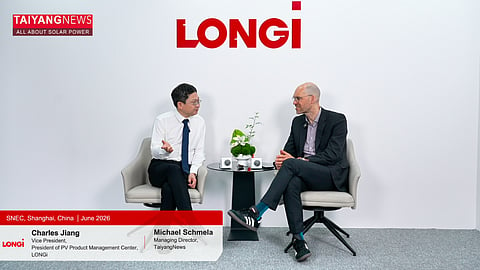


LONGi is accelerating its transition toward back-contact (BC) technology as it expands beyond residential applications into utility-scale projects and integrated energy solutions. In this interview with TaiyangNews, Charles Jiang, President of LONGi's Product Development Center, discusses the company's BC roadmap, product differentiation strategy, quality and reliability approach, storage ambitions, and why he believes BC could account for more than 70% of the PV market by 2030.
TaiyangNews: Let's start with the big picture before we get into the technology details and what's on the industry's mind these days. These are interesting times for the sector. The industry's development has also taken some unexpected twists over the past few months due to geopolitical developments.
So, before we get into the technology, let's talk about your new role at the center. Could you talk about your product development philosophy? Has anything changed, and in what direction are you moving?
Charles Jiang: First, let me explain the change in my role. Previously, I was President of the EG Business Group, responsible for LONGi's entire distribution business, representing roughly 36 GW of sales. I have now taken on the role of President of the Product Development Center. This is exactly the right time for LONGi's investments in technology to become a competitive advantage. Product leadership has always been one of LONGi's core strategies, starting with monocrystalline technology. When we began developing our BC technology, we introduced BC 1.0, followed by BC 2.0 in 2023 and 2024. Today, we have further evolved the platform to HIBC.
Many people questioned LONGi's choice 2 years ago. They wondered whether the company's founders and leadership had made the right decision. BC technology is difficult. The manufacturing process is more complex, and costs are higher. There were many questions about whether this was the right path. However, after 3 years, we have evolved the technology from 1.0 to 2.0. Today, I am very proud of HPBC 2.0. It is the most advanced technology in the PV industry, not only from a technology perspective, but also from a commercialization perspective.
A product that cannot be commercialized remains in the lab, and that means very little. HPBC 2.0 is already commercialized. Cost levels are now almost the same as TOPCon, while yield rates have reached 99%. In addition, the power output is 20-30 W higher than that of TOPCon. This makes HPBC 2.0 a highly competitive technology that has successfully moved into commercialization.
That is why I am excited to lead the Product Development Center. Over the past 2 years, my role was to bring this technology to market. Today, my role is to help drive broader adoption of this technology across the industry.
Some competitors have also launched BC technologies with different characteristics, but I have yet to see significant commercialization volumes. What is encouraging is that BC is now gaining acceptance across a much larger portion of the market. It is no longer limited to distributed generation, but is increasingly being adopted in utility-scale applications as well.
For example, in China, BC accounted for 22.5% of utility-scale 5.0 RFQ projects in the first half of the year. This shows that many IPPs have already accepted BC as the right choice.
TaiyangNews: And that's the interesting thing. In the beginning, very few people had doubts about BC in the residential segment. The technology is attractive, with its clean all-black appearance, and it is something homeowners want on their rooftops.
At the same time, rooftop space is limited, so there are many compelling arguments in its favor. Utility-scale applications, however, were a different story. That was where many people paused and said, ‘Wait a minute!’
Charles Jiang: Most people, including many companies, already agree that BC is a very good technology for distributed generation applications because of its appearance, anti-shading capabilities, and resistance to hot spots.
At this stage, however, BC is no longer limited to residential and C&I applications. Utility-scale customers are also choosing BC because of its higher power output, temperature coefficient, and cost advantages. That is why I am excited about this role. It gives me the opportunity to help bring BC technology into all application areas. One of my key priorities is to continue pushing BC forward. We will gradually convert our current TOPCon production lines to BC. By next year, we expect to be almost entirely BC. We will no longer have TOPCon product lines and will transition them to BC.
The second priority is to expand BC technology beyond residential and C&I applications into utility-scale projects. The third is to develop differentiated products based on the opportunities provided by the BC platform.
For example, we can develop products such as full-black modules, anti-dust solutions, and anti-corrosion products. For utility-scale applications, we are also developing anti-snow solutions. All of these differentiated products can be built on the BC technology platform.
I believe choosing BC technology has created more opportunities for LONGi to develop differentiated products than TOPCon. It gives us more possibilities to create products tailored to specific customer requirements. Otherwise, modules simply become a commodity, and that is something I do not want to see.
TaiyangNews: Let's talk a little about how you position BC within your portfolio. As you mentioned, it is ultimately expected to cover your full portfolio across both the distributed generation and utility-scale segments.
Charles Jiang: I think the 2 segments have different priorities. Utility-scale customers focus on balancing power output and cost. They are focused on LCOE and want reliable, high-quality products. Operating conditions in utility-scale projects can also be very demanding.
For distributed generation, customers often have specific functional requirements. Fire safety is particularly important because it directly relates to module safety. In addition, dust and dirt can affect power generation in many community and rooftop applications.
BC technology can address the needs of both segments. For utility-scale projects, BC delivers the highest power output, together with bifacial performance. We will also develop features such as anti-snow functionality. These are all designed to support reliable products with 30-year warranties. That is how BC will serve the utility-scale segment.
For distributed generation, each application may be relatively small in volume, but customers are often willing to pay a premium for products that meet their specific requirements. For these applications, we are developing products such as anti-glare modules and lightweight designs, particularly for older factories where roof load capacity may be limited.
We will continue to develop these features on top of the BC platform. While these products may carry a premium, many customers are willing to pay for them because, over a 25-year period, safety, reliability, and functionality are the most important considerations.
TaiyangNews: Module prices have fallen so much that, in many cases, hybrid inverters and mounting systems cost as much as, or even more than, the modules themselves?
Charles Jiang: Exactly, sometimes even more. That is why customers appreciate special features, even if they come with a modest price premium. For example, in Germany, fully black modules have become a preferred choice for rooftop installations. Customers typically look for high power output, anti-glare performance, and a full-black appearance. They see this combination as the ideal solution for many rooftop applications.
TaiyangNews: What's interesting is that modules have traditionally been viewed as commodity products. Yet customers are increasingly willing to choose differentiated products and pay a premium for them, rather than focusing only on lower prices.
Charles Jiang: Exactly. That is why I really appreciate the decision made by LONGi's leadership and founders. Think back to 3 years ago. Why choose the more difficult path? BC technology was challenging from both a manufacturing and cost perspective.
We could have chosen TOPCon from Day 1. In fact, LONGi set the first world record for TOPCon. But we chose BC technology because we believed it could provide customers with more choices and better meet their requirements, rather than simply offering another commodity product. LONGi does not want solar modules to become commodities. We want them to be products that play a role in people's everyday lives. That is the reason we chose BC technology. Many people in the industry questioned that decision, and some thought LONGi simply wanted to be different. But that was never the objective. The decision was based on what we believed customers would ultimately want.
TaiyangNews: LONGi recently reached the top position in the TaiyangNews TOP SOLAR MODULES ranking, surpassing 25% module efficiency. How do you view the C&I segment, which is also part of the distributed generation market? How is this segment embracing BC modules?
Charles Jiang: C&I customers focus on 2 key aspects. First, they are highly focused on power generation because rooftop space is limited. They want to generate more electricity from the same area. Unlike utility-scale projects, where land availability is often less constrained, rooftop space is fixed. With BC technology, we can generate 8% more green power within the same area.
The second aspect is safety, particularly fire safety. Customers also value features such as anti-shading and anti-hotspot performance.
In addition, we offer lightweight designs for rooftops with load limitations. In some markets, such as Switzerland, hail resistance is also an important requirement. Our modules with 3.2 mm and even 4.0 mm glass are designed to meet those requirements.
TaiyangNews: You mentioned that LONGi has already built significant BC capacity. At the same time, BC modules are not always easy to obtain in Europe, which suggests demand has picked up considerably. We are seeing similar trends in other markets as well.
Could you tell us more about your expansion strategy, shipment plans, and the markets you are focusing on?
Charles Jiang: As I mentioned, our strategy is to transition fully to BC. We currently have roughly 60 GW of BC capacity, and by the end of this year or the beginning of next year, that could reach around 80 GW.
Today, BC is being adopted in almost every major market. In China, it is gaining traction in both utility-scale and C&I applications. In Europe, adoption is strongest in the C&I and residential segments.
We are also seeing growing interest in emerging markets such as Latin America and the Middle East. Customers in these regions value high-efficiency products because they can generate more power, even at a modest price premium.
Beyond the product itself, we are also working on technology developments such as ACM, which improves gridline reliability. As gridlines become increasingly fine, reliability becomes more challenging. ACM increases both gridline thickness and contact robustness. We expect ACM-related capacity to reach almost 20 GW by the third quarter.
We also have HIBC technology, with almost 600 MW of capacity. It is targeted at the premium residential segment and has been very well received.
At the same time, we continue to develop products for various application scenarios while also investing in emerging technologies. HIBC has achieved world-record cell efficiency, and our perovskite tandem technology has also achieved world-record performance.
This means we are not only commercializing today's technologies, but also preparing for the next generation of technologies. Looking at the premium high-efficiency segment, I believe LONGi could achieve a 50% market share next year.
Of course, profitability is important. We are a business and have a responsibility to our shareholders. The industry has tested the patience of many investors in recent years, but I believe the work we are doing today will begin to pay off next year.
TaiyangNews: Could you tell us more about your efficiency roadmap and product development strategy? LONGi now has a module with more than 25% efficiency. What are you working on at the moment?
Charles Jiang: We certainly have that product, but it will remain one part of our portfolio.
As I mentioned, with 60 GW today and potentially 80 GW of capacity in the future, you need product segmentation. You cannot serve an entire 80 GW portfolio with a single product.
Our highest-efficiency products, including those exceeding 25%, will be targeted at premium applications and space-constrained installations. At the same time, we will continue to offer products for utility-scale projects, where cost and LCOE remain key considerations.
Different customers have different requirements, so our strategy is to segment the portfolio accordingly and develop products for different application needs.
TaiyangNews: Let's also talk about quality and reliability. These have always been important topics for LONGi.
Charles Jiang: Many customers are concerned about new products. When a new technology is introduced, some people worry about quality and reliability because they feel they may be taking the risk of adopting it first.
At LONGi, product quality is at the core of our business. Whenever we develop a new product, it must undergo rigorous qualification and testing procedures. We conduct extensive testing in our laboratories before any product is released to customers.
Our Chairman often emphasizes one principle: whatever product we ship to a customer should arrive without cracks. If a customer finds a cracked module upon delivery, LONGi will take responsibility. We call this our ‘zero-crack’ commitment.
This is just one example of how seriously we take quality. We view our products as 30-year products, and quality is fundamental to that approach.
At LONGi, quality is the brand, and the brand is quality. If you compromise on quality, you damage the brand. That is why quality is such a core part of our management philosophy. It is part of the DNA of every product we make.
From a manufacturing perspective, BC technology was more challenging in the beginning. However, through close collaboration with our ecosystem partners, particularly equipment suppliers, the technology has become increasingly mature. Since upgrading to HPBC 2.0, our manufacturing quality and yield rates have reached a level comparable to TOPCon.
TaiyangNews: Battery storage is currently one of the hottest topics in the industry. LONGi took its time in selecting both the technology and the right partner before entering the market. Could you talk about the thinking behind that decision and how you are developing your storage technology and product portfolio?
Charles Jiang: We believe this is the right time to enter the battery storage market.
As PV deployment continues to grow, storage becomes increasingly important because the grid cannot absorb unlimited amounts of solar generation. We believe our customers need an integrated solution that combines both PV and storage. Rather than having customers purchase PV from LONGi and storage from another supplier, we want to provide a complete solution. Internally, we describe this as one system, one platform, and one responsibility.
That is why LONGi decided to enter the storage market. The next question was how to enter it. We chose to acquire that capability by partnering with and investing in a company that had strong technical expertise, substantial manufacturing capacity, and extensive industry experience. The company already had significant deployment experience and established manufacturing capacity. We believe acquiring those capabilities and integrating them into LONGi was the right approach.
We launched products for utility-scale and C&I applications. Residential storage is not part of the portfolio at this stage. These are the segments where we see strong synergies between PV and storage, and where our existing customer base can benefit from a combined solution. That is why the concept of one system remains central to our strategy.
TaiyangNews: Utility-scale storage is currently one of the fastest-growing segments. Storage can help reduce the impact of negative electricity prices and improve energy capture from PV systems.
Which markets are you focusing on, and where will these products be available?
Charles Jiang: Our primary focus markets are China and Europe.
China has experienced tremendous PV growth over the past 5 years. Growth is now stabilizing because the grid cannot absorb unlimited amounts of solar generation. As a result, there is a strong demand for storage systems to help balance the grid.
Europe is another key market. Much of the grid infrastructure has been in place for decades and cannot be upgraded quickly. Storage can help absorb excess generation and address the challenges associated with negative electricity prices.
Recent increases in energy costs have also strengthened the case for integrated PV-plus-storage solutions. For these reasons, China and Europe will be our primary focus markets. Another important factor is bankability. Many large IPPs rely on project financing from banks. Banks often look for AAA-rated suppliers for such investments. LONGi has maintained that AAA bankability position in the PV industry, and we intend to bring the same level of confidence to our storage business.
TaiyangNews: So bankability is one differentiator. Where do you see the others? At the moment, it seems that everyone is moving into storage, including inverter manufacturers.
Charles Jiang: It is not that easy. Storage requires more than simply investing money.
First, we have strong expertise in PV, particularly in BC technology. That is our foundation. We believe the combination of high-efficiency PV and storage creates a value proposition greater than the sum of its parts. Higher-efficiency PV generates more energy, and storage helps maximize its value.
Second, regarding storage technology, we were not determined to develop everything ourselves. Sometimes, acquiring capabilities is a smarter approach than building them from scratch.
Some competitors entered the storage market earlier and developed their own capabilities internally. However, storage technology is evolving very quickly, and we believe it is important to learn and move intelligently.
That is why we chose to acquire a company with more than 10 years of experience in storage technologies, including BMS, PCS, and EMS. These systems were all developed in-house.
As a result, we can provide a fully integrated platform and take full responsibility for the solution. If you source BMS, PCS, and EMS from different suppliers, integration becomes more complex. In our case, we can offer a full-stack solution through the capabilities we have acquired and integrated.
That gives us a strong position compared with starting from zero.
TaiyangNews: We have now entered the second half of the decade. Looking ahead to 2030, from both a product perspective and given your new role, how do you see LONGi's portfolio evolving? What will LONGi's overall offering look like by the end of the decade?
Charles Jiang: If I imagine what the industry could look like by 2030, I believe BC will become a major technology in the PV industry. In my view, more than 70% of the market could be based on BC technology.
Just as LONGi played a leading role in the transition to monocrystalline technology and many others followed that direction, I believe BC will become a dominant technology platform.
Of course, we do not expect to be alone. The entire industry should benefit from the technology's advantages rather than continue to rely on older technologies.
The second trend I see is that most major players will move towards providing complete solutions. Instead of offering only PV products, companies will increasingly provide integrated PV and storage solutions.
That is how I imagine the market evolving by the end of the decade.
TaiyangNews: Thank you for the interview.
