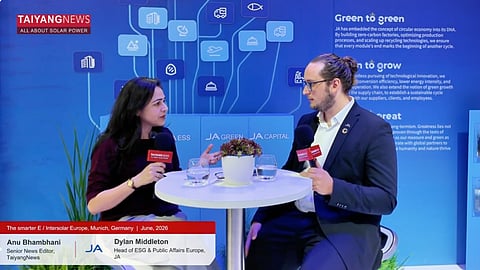


As sustainability becomes an increasingly important focus for the solar industry, low-carbon solar modules and decarbonization strategies are gaining momentum. At Intersolar Europe 2026, TaiyangNews’ Senior Editor, Anu Bhambhani, spoke with Dylan Middleton, Head of ESG and Public Affairs Europe at JA, about the company's approach to reducing embedded carbon and its latest white papers.
TaiyangNews: JA is highlighting its low-carbon solar modules at Intersolar Europe. As Head of ESG and Public Affairs Europe, what does ‘low carbon’ concretely mean for JA's products and manufacturing?
Dylan Middleton: For JA, ‘low carbon’ is about finding tangible ways to reduce the embedded carbon. And it focuses on supply chain innovation, material selection, and manufacturing optimization. It is not about a single technology or a marketing claim, but a systematic approach across the value chain of reducing embedded carbon.
TaiyangNews: Could you tell us which specific technologies or practices JA has adopted to reduce its carbon footprint across its manufacturing and supply chain?
Dylan Middleton: When we talk about decarbonization at the group level, the first point to consider is our verified science-based net-zero target. On the technology side, we focus our efforts and innovation on the carbon hotspots within the supply chain. About 30% of the module’s carbon footprint comes from polysilicon, while just under 30% comes from other material inputs. Cell manufacturing is another carbon hotspot due to its high energy usage. Our focus is to reduce this through material selection.
For example, we are looking at innovations in polysilicon technology, such as Fluidized Bed Reactor (FBR) technology, to bring down the embedded carbon in our modules. We combine this with a broader circularity concept by using a higher share of recycled polysilicon upstream in the value chain to further reduce the module's carbon footprint.
TaiyangNews: How does this ‘low carbon’ positioning translate into value for European customers, given that the EU has so many policies around that? So how are you positioning it?
Dylan Middleton: It positions us as one of the very few manufacturers capable of producing low-carbon products at scale. It also allows us to offer products with verifiable carbon emissions to our clients in the European and global markets. For every product procured from JA, customers can see what those emissions look like.
When we talk about JA's specific low-carbon product on the module side, it's what we call ITS Low Carbon. It is our traceable low-carbon solar module solution. It maintains quality, performance, reliability, and warranty coverage without compromising any technical parameters. Its carbon footprint is only about 57% of that of traditional mainstream mass-produced modules today. That's one of the fundamental differences.
TaiyangNews: JA is also releasing 2 white papers at Intersolar Europe 2026. One of them focuses on renewable energy and energy security from an industry perspective. What prompted JA to publish this paper now, and what is the central message you want to convey to policymakers and other stakeholders?
Dylan Middleton: Absolutely. This is one of two white papers we are launching at Intersolar Europe 2026. We developed it together with the Global Solar Council.
We've seen recent disruptions to the energy supply system and the knock-on implications they have had not only for the energy market, but also for economic competitiveness and consumers. Energy security is a fundamental topic for a renewable energy manufacturer like JA, and we want to contribute to the ongoing dialogue on the role renewable technologies can play in strengthening it.
The paper looks at topics such as barriers to deployment and how to address them. It also acknowledges supply chain dependencies on critical materials, while providing an industrial perspective on balancing those challenges with overall global energy security.
TaiyangNews: JA is also launching another white paper, the Green Token Index for Artificial Intelligence Data Centers (AIDCs). What does the Green Token Index mean, and how does it help data center operators in Europe?
Dylan Middleton: The Green Token Index white paper is driven by what we're seeing from an industrial perspective: a growing demand from AI-powered data centers and a significant increase in energy demand. It aims to create a harmonized language to compare computational outputs, energy inputs, and sustainability metrics.
It also seeks to establish a common framework for assessing the sustainability of AI computation and the energy that powers it, including the use of renewable energy.
TaiyangNews: Thank you.
This is an edited version of the transcript, and the full version can be watched here.
