

Industry insiders say a new round of solar demand has already started – but will it reach the scale of 2022, and what does it mean for pricing, policy, and the battle between hardware and software?
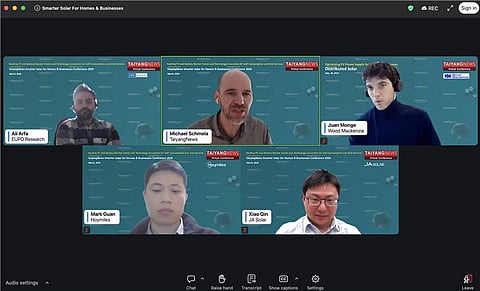
At the TaiyangNews Smarter Solar For Homes & Businesses Virtual Conference, 4 leading voices from across the solar and storage industry came together for a wide-ranging panel discussion – moderated by Michael Schmela, Managing Director of TaiyangNews – covering the immediate market impact of the Middle East conflict, the future of plug-in and residential solar, the regulatory and policy headwinds facing mature markets, the rise of intelligent energy management, and what the industry needs to do right now to capitalize on the current opportunity.
Below is an edited and categorized summary of the panel discussion. The full video of the panel discussion is available on the TaiyangNews YouTube channel here.
Participants:
Michael Schmela – Managing Director, TaiyangNews
Ali Arfa – Data Manager, EUPD Research
Juan Monge – Principal Analyst, Distributed Solar, Europe, Wood Mackenzie
Mark Guan – RESS Global Sales Director, Hoymiles
Xiao Qin – Head of Module Product Management Department, JA Solar
Regarding the impact of the Middle East conflict on demand, could you briefly share how the past 4 weeks have translated into orders, interest, or inquiries?
In recent weeks and months, we’ve seen a rapid increase in demand across global markets, particularly for PV and residential storage. This appears to be driven by the conflict in the Middle East, which has pushed up electricity costs and heightened concerns around energy security. As a result, both PV and storage markets are experiencing strong growth. In my view, a new wave of demand is already underway, and customer feedback confirms very high order volumes.
Ali, what are you hearing from installers?
The impact is still unfolding and will likely reach installers, especially in Europe, with some delay. I agree with Mark, but it’s important to assess this market by market.
Countries reliant on Middle Eastern oil and gas, such as Italy, will see a stronger impact. In Asia, however, the effects are already more visible. This situation resembles the Ukraine crisis, but with a stronger immediate impact on Asia. Even if the conflict ends soon, normalization of LNG and oil markets could take months or years, creating prolonged ripple effects.
Qin, what is JA Solar’s perspective?
We are seeing similar trends. Demand is increasing, and many customers are actively requesting our modules. Overall, this is a positive signal.
The residential segment remains complex, but plug-in solar is gaining traction due to its simplicity. How is regulation influencing the market?
Plug-in growth has been highly localized, especially in Germany, largely due to regulatory flexibility. Requirements such as mandating electricians can significantly increase costs and limit adoption.
New safety standards, such as those introduced in Germany, could help expand adoption across Europe. Markets with more apartment dwellers, like Spain, Italy, and France, are strong candidates for future growth.
Mark, your view?
We see strong growth potential in both plug-in PV and plug-in storage. For apartment residents, plug-in solutions offer real energy independence, which is driving demand.
Could we shift from oversupply to bottlenecks again?
There is still excess inventory in the system, and manufacturing expansion continues. While demand will grow, it’s unlikely to match the 2022 boom. However, supply chain disruptions remain a wildcard.
I agree. Several structural factors, US policy shifts, plateauing European demand, and rising manufacturing capacity, suggest a more balanced but still complex market. However, geopolitical disruptions could quickly change this.
Mark, are you prepared for a surge in demand?
Yes, we’ve built up inventory and are well-positioned for growth.
Should we expect price increases?
Prices are stable now, but we anticipate increases due to battery and material constraints.
Juan, since you model markets, are rapid policy responses, like in the UK, factored into your assumptions?
Yes, particularly in residential markets, which are highly sensitive to incentives. UK measures like zero VAT and supportive regulations are reflected in our modeling.
However, broader political and social dynamics also play a role. While policy support matters, long-term demand is increasingly driven by economics, especially rising electricity prices and self-consumption.
Mark, you showcased sophisticated tools, including participation in electricity markets. What level of sophistication do customers actually want and use?
Our data shows that intelligent energy management is becoming central. Customers are using these systems to optimize consumption, reduce electricity bills, and even generate income through dynamic trading.
Looking ahead, these systems will provide more flexibility, energy independence, and new value streams. They also benefit grid operators by improving stability and balancing supply and demand.
How do expectations differ between residential and C&I customers?
There’s been a clear shift. Storage used to be mainly for backup or storing PV output. Now, it’s becoming an active participant in energy markets.
This is especially advanced in C&I, but increasingly relevant for residential users as well. Storage is evolving into the core of energy management and trading.
Qin, how important is integration for JA Solar?
We currently provide modules and storage separately, but we see strong potential in offering more integrated solutions, especially tailored combinations based on customer needs.
How does that work through distribution?
We focus on storage as a key driver. Based on customer energy usage, we recommend optimized combinations of modules and storage to deliver a complete solution.
Mark, how is your distribution strategy evolving?
We don’t have a one-stop solution. However, we collaborate with distributors who may bundle our systems with products from other manufacturers to deliver complete solutions.
Is the industry moving toward full integration?
Possibly, but it will take time. Panel and electrical manufacturing require different expertise. For now, companies will focus on their core strengths while gradually integrating.
How is digitalization changing your service model?
We’re investing in localization, regional teams, warehouses, and service centers to provide faster and better support.
Ali, what are installers saying?
After-sales support is critical. Installers also prioritize financially stable and reliable brands, especially in the C&I segment, where projects are long-term commitments.
While residential demand has softened slightly, C&I and rooftop segments are gaining importance.
What should the industry do to capitalize on current opportunities?
Clear communication is key. Installers must articulate value, especially in an environment of high electricity prices. Transparency and strong narratives are essential.
Future opportunities like virtual power plants (VPPs) will further strengthen the business case.
So now is the time to invest in marketing?
Exactly.
Ali?
Companies must adopt data-driven, localized strategies. Strong technology alone isn’t enough; execution matters.
Mark?
We are cautiously increasing inventory while preparing for potential volatility. Careful planning is essential.
What product trends do you expect?
Customers will prioritize intelligence, usability, and performance. The focus will shift toward software, energy management, and economic value.
Thank you all for the insightful discussion, and thanks to our audience and sponsors.
