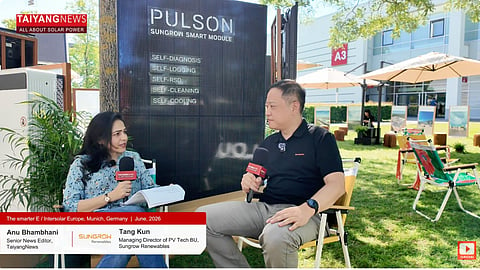


Solar modules continue to improve efficiency and power output. At the same time, a few manufacturers are focusing on module intelligence, making them smarter and AI-enabled. One such company is Sungrow Renewables, which recently launched a smart module named ‘Pulson’ at SNEC 2026.
During Intersolar Europe 2026, TaiyangNews Senior Editor Anu Bhambhani spoke with Tang Kun, Managing Director of the PV Tech Business Unit at Sungrow Renewables. He discussed the Pulson smart module’s features, capabilities, and operation & maintenance (O&M), while also providing an overview of Sungrow Renewables' global operations.
TaiyangNews: Could you give us an overview of the company's core business?
Tang Kun: Sungrow Renewables is the subsidiary of Sungrow Power Group, specializing in solar energy, wind energy, EV charging and storage, and integrated multi-energy projects. The company offers end-to-end solutions, from technical research, project investment and development, to project design and construction, and all the way to final project O&M. So our business covers large, medium, and small power plants, as well as distributed mini power plants. The company has installed more than 59 GW of solar and wind power plants over the past 13 years.
TaiyangNews: Over the last decade, innovation in the PV industry has largely been focused on improving cell efficiency, increasing the module output, and reducing LCOE. Sungrow Renewables, on the other hand, believes module intelligence will become a key innovation direction for the next phase of industry development. Can you explain the rationale behind this belief?
Tang Kun: High module power alone cannot solve all the problems or pain points of a project customer. Challenges such as poor system synergy, safety risks, low O&M efficiency, and a lack of asset evaluation remain. Module intelligence can transform solar modules from passive electricity-generation devices into active smart terminals that monitor and collect data, giving customers a better understanding of how their modules perform after installation.
TaiyangNews: Can you please elaborate on the key features of your recently launched Pulson smart module?
Tang Kun: The Pulson smart module is built around 5 key capabilities: self-diagnosis, self-rapid shutdown (self-RSD), self-logging, self-cleaning, and self-cooling.
The self-diagnosis function is powered by the company’s specially designed module controller. It is more than a conventional junction box, as it integrates advanced chips that collect data such as current, voltage, and temperature from the module. The idea behind the name Pulson is to ‘feel the pulse’ of the module by continuously monitoring and analyzing its operating data. AI algorithms help analyze, make decisions, and make O&M easier while reducing costs.
The self-RSD function works at both the module and system levels. At the module level, when a faulty module is detected, it can be automatically bypassed via a specially designed circuit so it does not negatively affect other modules in the same string, thereby allowing electricity generation to continue. At the system level, in emergency situations, the system voltage can be reduced to below 30 V within 25 seconds, which is considered a safe level for the human body.
The self-logging function records manufacturing information, module parameters, production date, EL images, and IV curves throughout the module's lifecycle. It creates a trusted connection between the company and customers by providing a complete record of module quality. The information is also useful for plant owners, insurance companies, financing institutions, and asset evaluation, supporting bankability and helping reduce the initial investment cost.
The self-cleaning and self-cooling functions combine nanoscale super-hydrophilic surface treatment technology with Sungrow's self-developed cooling technology to reduce losses caused by dust and heat. Depending on the site conditions, particularly in dusty or high-temperature environments, these technologies can improve electricity generation by up to 6%.
The 5 capabilities are designed to make modules smarter, safer, and more efficient by transforming them from passive electricity-generation devices into active smart terminals that monitor, collect, and record operational data, giving customers a better understanding of module performance after installation.
TaiyangNews: What do you see as the key technological, commercial, or ecosystem challenges that need to be addressed before smart modules can achieve large-scale adoption?
Tang Kun: Smart modules have a great opportunity in the global market. The first step is to deploy them in our own projects because the best way to prove a new technology is to use it ourselves first. With projects around the world, we have the opportunity to validate the technology under real operating conditions. We have also worked closely with our supply chain partners to ensure the quality of the smart modules, so quality should not be a concern for customers.
The biggest challenge for large-scale adoption is how to quantify the value of intelligence. Intelligence only matters if it can deliver measurable value to project customers. Smart modules provide an opportunity to quantify that value by demonstrating whether they can increase electricity generation, improve operational safety, reduce O&M costs, and optimize asset management. We're going to face these challenges, but I think we can deal with it over time. Module intelligence will be the future trend.
TaiyangNews: Thank you for the interview.
This is an edited version of the transcript, and the full version can be watched here.
