

TOPCon solar cell technology has taken over the global solar PV industry by storm. In a short time, it took over the mantle of becoming the industry’s workhorse from PERC. In a world of quickly expanding technological advancements, when other cell technologies are gaining ground, how much more does TOPCon have to stay at the top?
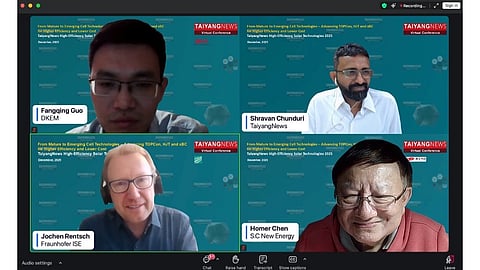
The panel discussion on Day 2 of the TaiyangNews High Efficiency Solar Technologies 2025 Conference on December 4 delved into the subject. The panel comprised Fraunhofer ISE Head of Technology Transfer Jochen Rentsch, the Associate Dean of Research Institute, Shenzhen S.C New Energy Homer Chen, and DKEM’s Director of New Technology Development, Fangqing Guo. It was moderated by TaiyangNews Head of Technology, Shravan Chunduri.
Here’s an edited summary of the panel discussion.
TaiyangNews: TOPCon is now the industry’s workhorse, but where does it stand today, how much improvement is still possible, and how mature is the current generation?
Jochen Rentsch (Fraunhofer ISE): Industrial TOPCon cells today average around 25.5% efficiency, with realistic near-term potential to reach about 26% and possibly 27% through incremental improvements. Beyond this, progress will slow as the technology approaches theoretical limits. This applies not only to TOPCon, but also to IBC and heterojunction (HJT). Further gains would require disproportionate effort, making tandem cells the next major step. Since TOPCon is already in mass production, it can be rated at level 5, with future gains being evolutionary rather than disruptive.
Homer Chen (Shenzhen S.C New Energy): TOPCon will eventually approach its efficiency ceiling, but many challenges remain in mass production. Automation is critical, as manual handling causes variability in yield and efficiency. Fully automated lines deliver more stable results, higher average efficiency, and better control of contamination. Improved automation benefits TOPCon as well as other technologies like HJT.
TaiyangNews: On a development scale of 1 to 5, where does TOPCon stand today?
Homer Chen (Shenzhen S.C New Energy): Around 3.5. There is still room to reduce costs, especially silver usage, explore copper or nickel alternatives, improve deposition precision, and further optimize texturing and layer control.
TaiyangNews: From a metallization perspective, how mature is TOPCon?
Fangqing Guo (DKEM): I would rate it at 4. Loss analysis shows room for improvement, especially on the front-side contacts. Contact resistivity and metal usage are still higher than in some alternative structures. There is more potential on the front side than the rear side, while cost reduction through alternative metals remains an important opportunity. These factors can extend TOPCon’s competitiveness.
TaiyangNews: What have been the most important innovations over the last year, and what is the realistic efficiency ceiling for industrial TOPCon without major structural changes?
Jochen Rentsch (Fraunhofer ISE): Metallization has seen steady progress, especially finer fingers enabled by laser-enhanced processes. Rear-side poly fingers are gaining attention, but they introduce trade-offs, such as reduced lateral conductivity compared to full-area contacts. These developments show promise but still need validation in production. Overall, efficiency gains are incremental, and structural simplicity remains important.
TaiyangNews: From an equipment perspective, what advances matter most?
Homer Chen (Shenzhen S.C New Energy): Edge passivation is currently the most impactful improvement, supporting higher efficiency and flexibility for half- or third-cut wafers. Thinner backside poly layers and optimized annealing reduce parasitic absorption and improve low-light performance. Zero-busbar (ZBB) designs are also being explored to cut silver consumption, while more complex emitter structures are becoming less attractive due to cost.
TaiyangNews: What metallization advances beyond laser-based processes have helped TOPCon?
Fangqing Guo (DKEM): Fine-line printing has been critical. It required smaller silver and glass powders, changing paste formulations, and improving contact properties. Fine-line designs also allow higher finger counts and better front-side layouts, improving efficiency while offering cost reduction options.
TaiyangNews: IP conflicts are often seen as a major bottleneck. How can companies address this?
Jochen Rentsch (Fraunhofer ISE): There is no simple solution to this. Companies must carefully assess licensing requirements before entering production. Equipment freedom to operate does not automatically cover the cell structure itself. Many large players resolve disputes through settlements or cross-licensing. New entrants can partner with others to strengthen their IP position and reduce risk.
TaiyangNews: What are the most realistic upgrades for existing TOPCon lines?
Jochen Rentsch (Fraunhofer ISE): Small structural improvements must be weighed against added process complexity and cost. A minor efficiency gain may not justify significant new CapEx. However, higher efficiency can help access premium markets. Decisions should balance cost, output, and market positioning.
TaiyangNews: How complex is TOPCon Plus in high-volume manufacturing?
Homer Chen (Shenzhen S.C New Energy): It is manageable and similar to turnkey production. The focus should be on structural optimization, especially precise deposition and doping of ultra-thin tunneling layers. These improvements can be implemented on existing equipment and help reduce recombination losses, improve bifaciality, and lower long-term production costs.
TaiyangNews: What does TOPCon Plus mean for metallization?
Fangqing Guo (DKEM): Poly-finger processes slightly change paste recipes but rely heavily on finer line widths. Below certain screen sizes, powder dimensions become a limiting factor, requiring further material innovation. Extremely narrow lines may eventually require new metallization concepts.
TaiyangNews: Can advanced concepts like double-sided poly contacts compete with BC, or is tandem the next real step?
Jochen Rentsch (Fraunhofer ISE): Simulations and record cells show TOPCon can approach BC performance through optical and contact improvements. However, poly layers on the front side increase absorption. If the industry moves to tandem, TOPCon is a strong bottom-cell candidate. Tandem offers the next major efficiency leap.
Fangqing Guo (DKEM): Most customers avoid full bi-poly structures due to high investment and limited efficiency gains, especially since laser-based processes reduce the gap. Some are exploring simpler approaches that achieve similar effects with lower cost.
Homer Chen (Shenzhen S.C New Energy): Ultimately, decisions will depend on average mass-production efficiency and total cost. Practical performance matters more than record results.
TaiyangNews: If the industry could focus on one key innovation to keep TOPCon mainstream for the next 3 years, what should it be?
Jochen Rentsch (Fraunhofer ISE): Continue incremental improvements and fully integrate existing advances, especially poly-finger optimization. TOPCon has not yet reached its industrial limits.
Homer Chen (Shenzhen S.C New Energy): Automation remains critical to improve consistency, yield, and stability. Simple, well-controlled layer structures are more reliable in mass production.
Fangqing Guo (DKEM): Reducing silver consumption is key. Fine-line and silver-saving designs give manufacturers flexibility to balance efficiency and cost.
TaiyangNews: Should the industry move from TOPCon to BC before tandem, or directly from TOPCon to tandem?
Jochen Rentsch (Fraunhofer ISE): Directly from TOPCon to tandem. Adding BC in between complicates the transition.
Homer Chen (Shenzhen S.C New Energy): Tandem is the long-term direction, but durability, lifetime, and mass-production challenges must be addressed.
Fangqing Guo (DKEM): TOPCon and BC will coexist for some time, but TOPCon can transition directly to tandem. Switching to BC requires major investment and line stoppages, which are not realistic for many manufacturers.
TaiyangNews: The verdict of today’s panel is that BC is an option, not a requirement. TOPCon remains strong and can evolve directly into tandem technology.
Conference summaries for all 4 days of the event, along with edited panel discussions, are available on the TaiyangNews website.
