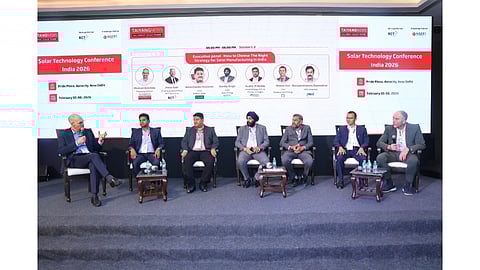


At the TaiyangNews Solar Technology Conference India 2026 (STC.I 2026) held on February 5-6 in New Delhi, executives from India’s leading solar PV manufacturers said scale, cost leadership, and vertical integration are shaping manufacturing strategies. They also warned of short-term capacity pressures, skill gaps, and ecosystem bottlenecks as the country rapidly expands its solar supply chain.
The executive panel on Choosing the Right Strategy for Solar Manufacturing in India was moderated by Michael Schmela, Managing Director of TaiyangNews, and Peter Fath, Founder and CEO of RCT Solutions. Panelists were:
Sudhir M Reddy, Chief Strategy Officer, Premier Energies
Balachander Krishnan, Chief Operating Officer, Indosol Solar
Hardip Singh, Chief Operating Officer, Grew Energy
Narayanaswamy Devendiran, Chief Marketing Officer, Emmvee
Omkar Jani, Chief Technology Officer, Reliance New Energy
Panelists agreed that large-scale, vertically integrated manufacturing is essential to remain competitive in an increasingly cost-driven global market. Here’s an edited summary of the ‘rockstar’ panel:
Michael Schmela (TaiyangNews): We are talking about potential overcapacity in India. Do you expect a shakeout similar to what happened in China?
Narayanaswamy Devendiran (Emvee): We may not see overcapacity at the same scale as China because lending in India is more cautious. However, some overcapacity will emerge. A first shakeout could happen at the module level once the cell ALMM is fully effective, likely around mid-2027. A second shakeout could follow at the cell level when ALMM for wafer manufacturing comes in around 2028. There will be natural selection over time, and we may see consolidation towards 2030 as the market stabilizes.
Michael Schmela (TaiyangNews): Do you see the Indian government stepping in, like in China, to control capacity expansion?
Narayanaswamy Devendiran (Emmvee): The government has already sent a circular to public sector banks advising caution in financing additional module manufacturing.
Omkar Jani (Reliance New Energy): India’s approach will likely differ from China’s. It is more market-driven. Rather than strict intervention, the government may let the market self-regulate.
Michael Schmela (TaiyangNews): Chinese manufacturers diversified into system integration and batteries during their period of overcapacity. Is diversification into batteries the right approach for Indian companies?
Balachander Krishnan (Indosol Solar): Our strategy is slightly different. If there is overcapacity, consolidation is expected. During that period, we are focusing on captive consumption and electrifying our own manufacturing plants rather than aggressively diversifying.
Narayanaswamy Devendiran (Emmvee): On batteries, we are still dependent on China for cells. In India, we largely import and assemble, which adds limited value. While battery deployment is necessary for grid stability, assembly alone is not a long-term survival strategy.
Sudhir M Reddy (Premier Energies): Battery energy storage will likely be a natural diversification. The Government of India has already released draft guidelines for BESS, similar to the module list mechanism. So this could become a logical extension for many manufacturers.
Michael Schmela (TaiyangNews): India has built a protective framework for domestic manufacturing. What more is needed to ensure cost competitiveness and quality?
Sudhir M Reddy (Premier Energies): Free markets drive innovation. As supply increases and competition intensifies, companies will focus on cost leadership – reducing gas, chemical, wafer, electricity, and water costs – while improving efficiencies. Investment in R&D will be crucial, whether it be improving TOPCon or exploring new technologies like BC.
Hardip Singh (Grew Energy): India already has a cost-effective ecosystem. As volumes increase, inefficiencies will decrease, skills will improve, and costs will come down. But protection is philosophical; if we compete against protected players, we may also need protection to ensure a level playing field.
Narayanaswamy Devendiran (Emmvee): If Indian manufacturers are competing against protected markets, India may also need protection to create a level playing field.
Peter Fath (RCT Solutions): How important is full ecosystem development – materials, glass, equipment – and should manufacturers prioritize Indian suppliers even if costs are higher?
Narayanaswamy Devendiran (Emmvee): Ecosystem development is critical. The major cost gap with China – 30–40% – is largely due to the bill of materials and financing costs. Interest accounts for perhaps 10–15%; the rest is BOM. That’s where India must focus.
Omkar Jani (Reliance New Energy): Some backward integration decisions are about supply chain security, not just economics. For example, we are investing in glass and encapsulant to secure supply.
Narayanaswamy Devendiran (Emmvee): In my view, equipment manufacturing in India does not yet make commercial sense at a 50 GW scale. China built thousands of gigawatts over a decade, enabling viable equipment ecosystems.
Sudhir M Reddy (Premier Energies): This is precisely where government support could help; supporting capital equipment development rather than manufacturers themselves.
Michael Schmela (TaiyangNews): Will the ALMM for cells proceed as planned?
Sudhir M Reddy (Premier Energies): Around 40 GW of cell capacity is expected to be operational by June. I believe the government will avoid policy reversals, as certainty is crucial for investor confidence. There may be a short-term shortage for a quarter or two, but capacity should meet demand over time.
Peter Fath (RCT Solutions): How important is workforce strategy in scaling up manufacturing?
Hardip Singh (Grew Energy): There is no shortage of manpower in India, but skill gaps exist. We are investing heavily in training and partnering with ITIs and skill development centers near our plants to build a steady talent pipeline.
Balachander Krishnan (Indosol Solar): As we scale from 3.4 GW to 10 GW, it is extremely difficult to find experienced process and R&D professionals. Attrition is high, and salary inflation is real. The competition for skilled resources is already intense.
Narayanaswamy Devendiran (Emmvee): There is also a significant gap between academia and industry. Many PhDs come with strong research backgrounds, but they are not always ready for industry requirements, which are focused on cost-effective, scalable processes. This gap needs structured training to bridge it.
Sudhir M Reddy (Premier Energies): We are investing more in automation and AI-driven systems. However, as equipment becomes more complex, maintenance capabilities must improve. Otherwise, resolution times increase and operational efficiency suffers.
Omkar Jani (Reliance New Energy): Beyond hiring, retention is becoming critical. Companies need structured retention strategies to hold on to strong process talent. At the same time, long-term solutions may require deeper collaboration between industry and research institutions, similar to research-led ecosystems seen in countries like Germany. Building that kind of institutional support will take time, but it is important for sustaining growth.
Peter Fath (RCT Solutions): Should India concentrate manufacturing in specific hubs?
Sudhir M Reddy (Premier Energies): I don’t think manufacturing hubs will be practical at this stage. Water and power availability are critical factors. Geographic diversification allows better resource management and access to regional manpower.
Michael Schmela (TaiyangNews): What is your export strategy, particularly regarding Europe and the US?
Sudhir M Reddy (Premier Energies): Pure export-led strategies are risky. Localization in markets like Europe and the US is essential. We plan to expand manufacturing abroad while keeping India as our primary base for skill development and knowledge.
Narayanaswamy Devendiran (Emmvee): Export opportunities depend heavily on protection mechanisms in those markets. Without some level of resilience requirement, pure exports may not be competitive.
Sudhir M Reddy (Premier Energies): Under the Net-Zero Industry Act (NZIA), Europe is emphasizing resilience and diversification. If local content or resilience mechanisms are clearly defined and economically viable, that could open doors for Indian manufacturers to localize or partner in Europe.
Audience Question: Where is India losing out on BOM costs compared to China?
Narayanaswamy Devendiran (Emmvee): India’s module BOM cost is about 8-9 cents per watt, while Chinese manufacturers claim 5-5.5 cents. Aluminum prices in India are pegged to LME and are higher than Chinese domestic prices. Copper and other metals show similar gaps. India also faces higher interest rates, around 9% compared to China’s 2-3%. These factors collectively widen the cost difference.
Audience Question: Will AI and data centers significantly increase solar demand?
Sudhir M Reddy (Premier Energies): Yes, data centers will significantly drive demand. The government’s recent tax incentives for data center investments could accelerate solar installations.
Audience Question: Is solar demand from green hydrogen being factored in?
Narayanaswamy Devendiran (Emmvee): Currently, green hydrogen projects have exemptions allowing imports. In the future, the government may require domestically manufactured solar modules for these projects.
Audience Question: What will determine which manufacturers survive long term?
Omkar Jani (Reliance New Energy): Survival will depend on cost competitiveness, product quality, and reliability. Strong operational execution will differentiate companies.
Michael Schmela (TaiyangNews): Thank you, all.
