

India is steadily shaping up to be a 50 GW annual market, while its nameplate annual manufacturing capacity is well over 144 GW today. Needless to say, a large part of this progress is driven by a favorable regulatory environment that has created not only demand but also the boundary conditions for domestic supply to grow quickly.
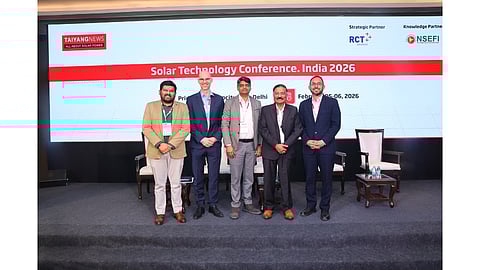
Looking ahead, India needs to ascertain the strategic guardrails it needs to achieve solar PV manufacturing autonomy. This was the subject of deliberation at the policy panel at TaiyangNews Solar Technology Conference India 2026 (STC.I 2026), held in New Delhi on February 5 and 6.
Moderated by TaiyangNews Managing Director Michael Schmela, along with National Solar Energy Federation of India’s (NSEFI) Assistant Director for Strategy, Manufacturing & PR, Shubhang Parekh, the panel examined India’s strategy to achieve solar PV manufacturing autonomy.
Panelists comprised:
Jai Prakash, Deputy Director General at the National Institute of Solar Energy (NISE), an autonomous institute under India’s Ministry of New and Renewable Energy (MNRE), NISE serves as the apex national R&D and capacity-building institution for solar energy, providing technical support to government programs, conducting research and testing, and supporting implementation of national solar policies.
Sandeep Garg, CEO of Landsmill Group, an Indian renewable energy and manufacturing enterprise that is establishing a 5 GW solar module assembly line using TOPCon technology in Madhya Pradesh, one of the larger capacities proposed in the Indian manufacturing landscape.
Rishabh Jain, Fellow at the Council on Energy, Environment and Water (CEEW), one of Asia’s leading policy think tanks focused on energy, climate, and sustainable development, offering analysis and policy recommendations on clean energy transitions, industrial competitiveness, and the economics of solar manufacturing.
Here’s the edited summary of the panel discussion:
Michael Schmela: What does solar autonomy and strategic resilience really mean from your perspective?
Rishabh Jain: When I talk about autonomy in the solar sector, I look at how concentrated global supply chains have become. A decade ago, Europe was a leader in technology and equipment manufacturing, but manufacturing shifted because of strong anchor demand in China. Manufacturing does not just move automatically; it follows demand.
In India, while we are increasing installations, I do not see deployment yet at a level that alone can sustain the 250 GW manufacturing capacity that is being discussed for 2030. Earlier, exports – especially to the US – played a big role. Around 98% of India’s solar module exports went to the US in 2025, and that supported domestic manufacturers.
Going forward, I believe autonomy must be supported by consistent domestic deployment of large projects. Manufacturing will only survive if there is steady demand. Along with that, we need R&D, skills, and equipment capability, but demand remains the biggest driver.
Sandeep Garg: Talking about overcapacity concerns, I do not see overcapacity as a negative. In my previous experience, I have seen that overcapacity can actually lead to better solutions.
However, I believe one key challenge is grid absorption. Transmission capacity and distribution systems are not fully ready to absorb all the solar power we generate. If solar generation cannot be integrated properly into the grid, then deployment alone will not solve the issue.
For me, solar autonomy means not just producing more panels but ensuring that we can absorb and use the energy efficiently. The recent push for pumped hydro storage, for example, is a good step because it allows us to store and utilize solar power more effectively.
Jai Prakash: From the Ministry’s perspective, autonomy is linked to our national climate commitments. We have a target of 500 GW of renewable energy by 2030, with around 292 GW expected from solar. By 2047, we are looking at more than 2,000 GW.
To ensure we meet these targets without supply disruptions, the government introduced policies like the PLI scheme and ALMM. We deliberately designed higher incentives for vertically integrated plants and local value addition to strengthen domestic manufacturing.
Solar cell capacity has increased from around 1 GW in 2015 to nearly 28 GW today. However, if we look at full domestic value chains, we still cannot produce more than about 17 or 18 GW of modules using fully domestic materials. So, autonomy is progressing, but we still need to strengthen upstream areas like wafers and polysilicon.
Michael Schmela: How should India balance supply chain risks, geopolitical tensions, and the need for rapid expansion?
Sandeep Garg: Risk is part of any business. We have seen geopolitical relationships fluctuate, but we have managed those risks. I believe India is competent enough to handle supply disruptions.
Yes, risk may come with additional costs, but with policy support from the government and adaptability from manufacturers, I believe we can manage that cost. Both policy push and industry capability exist today, which gives me confidence.
Rishabh Jain: After COVID, the government clearly shifted toward increasing domestic value addition through customs duties, ALMM, DCR projects, and PLI schemes.
However, one challenge is the technology transition. Solar technology is evolving quickly. If someone sets up a plant in 2026, they want the latest technology. But deciding when to invest is difficult because technology keeps changing. Financiers also question whether manufacturers are locking into the right technology.
Another challenge is building capabilities in areas where we have never manufactured before, such as wafers or advanced equipment. We need equipment immediately and at competitive costs, which limits our options.
In my view, we should focus strategically, build R&D capability, and strengthen ecosystem components like silver paste and other materials. It is a short- to long-term process, and patience is important.
Jai Prakash: I see technology transition as one of the biggest risks. We have moved from PERC to TOPCon, HJT, IBC, and possibly tandem technologies in the future. Manufacturers need to adapt quickly, but tools are mostly imported, and skilled manpower is limited.
While module manufacturing scaled quickly to 143 GW, cell manufacturing is more complex and takes time. PLI was announced in 2022, and we are in 2026 now, with some upstream components still requiring extensions.
To address this, we need dedicated R&D clusters and closer collaboration between manufacturers and research institutions. We also need trained manpower. At NISE, we have launched hands-on training programs to prepare graduates for production line work.
Shubhang Parekh: How does the EU-India Free Trade Agreement (FTA) affect India’s ability to diversify its solar supply chain?
Sandeep Garg: Technology development largely occurred in Europe, while manufacturing shifted to China mainly because of costs. I see the FTA as creating a partnership where technology can migrate to India and be produced at a lower cost.
This could lead to a strong collaboration between European technology providers and Indian manufacturers. For example, recycling could be an area where European technology, combined with Indian cost competitiveness, creates value.
I believe this agreement is a positive development and can support machinery imports and joint manufacturing solutions.
Rishabh Jain: The FTA discussions have been ongoing for many years. In terms of tariffs, the changes may not be dramatic. However, I see the agreement as politically significant. It signals alignment between India and Europe in a changing global context.
What may matter more is increased human-to-human engagement, industry delegations, and institutional collaboration. This can lead to the co-development of technology and stronger partnerships. Clean energy is an area where both regions are fully aligned. Over time, this alignment can lead to stronger collaboration in solar and related sectors.
Jai Prakash: On the technology side, we should not restart from scratch. We should adopt the latest available technologies while also working jointly with European institutions on future innovations. I believe a tri-party collaboration model involving Indian research institutes, European research institutes, and the industry would be effective. This would allow local support combined with global expertise.
Michael Schmela: What long-term principles, which act as strategic guardrails, should policymakers and industry leaders follow?
Sandeep Garg: I have seen a clear shift in policy stability over the last 3 to 4 years. Earlier, policies were sometimes reactive, but now they are more predictable and announced well in advance.
Policy consistency is essential for investment. Government support in the form of PLI and grants has also improved. These 3 pillars – policy stability, market integration, and financial support – have significantly changed the solar landscape in India.
Rishabh Jain: While protective policies like ALMM and customs duties are important, the ultimate focus should be competitiveness. We cannot try to do everything at once and spread ourselves too thin.
We need to prioritize strategic areas and gradually build ecosystem strength. Support mechanisms cannot continue forever, so the industry must prepare to compete globally. I agree with Sandeep that policy certainty is crucial. If deadlines are frequently extended, investor confidence may weaken. We need to ensure that commitments are followed through.
Michael Schmela: How do you think India will be viewed globally by 2030?
Sandeep Garg: I believe India will be seen as a resilient and competitive international solar manufacturer. As integration across the value chain increases, we will strengthen our global presence.
Jai Prakash: By 2030, I expect India to be largely self-sufficient in most segments. I do not see long-term dependence on heavy protection if we continue progressing as planned.
Shubhang Parekh: From an industry body perspective, I believe we will still require some policy support, especially in upstream areas like ingot and polysilicon. However, we will be dealing with more advanced challenges rather than basic capacity gaps.
Rishabh Jain: In the near term, some protection may continue. But over time, I expect India to evolve into a more open and competitive player in the global solar market.
Michael Schmela & Shubhang Parekh: Thank you, all.
