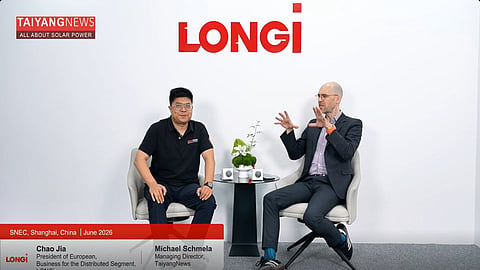

As Europe’s solar market continues to evolve, high-efficiency back-contact (BC) technology is gaining traction across residential, commercial & industrial (C&I), and utility-scale segments. At SNEC 2026, TaiyangNews spoke with Chao Jia, the President of European Business for the Distributed Segment of LONGi, who provided an overview of the company’s growing adoption of BC technology in Europe, regional market trends, brand-building strategies, after-sales service, and vision for integrated solar and energy storage solutions.
TaiyangNews:
Many congratulations on achieving No. 1 in TaiyangNews TOP SOLAR MODULES listing for having a 25% BC PV module. Could you please tell me about your European market?
Chao Jia:
Thank you for the recognition. In fact, I predicted LONGi’s climb to the no.1 position globally during a TV show at last year’s Intersolar Europe, primarily driven by 4 research & development (R&D) centers. As a matter of fact, our R&D investment equals the rest of the company’s budget. I think we will continue to achieve the BC module records, as we have most patents for the BC process and fabrication tools.
TaiyangNews:
It is not easy to get BC modules from China for several reasons, including geopolitical volatility, based on feedback from a few of my European buyers. However, they are currently looking into residential solar with BC modules, aiming to be energy-independent. Would you like to shed some light on this aspect?
Chao Jia:
From the beginning of 2025, aligning with the trend toward BC technology that offers high efficiency, reliability, and aesthetic appeal, LONGi began pitching its Hi-MO X6 series residential module in Europe. I think the rest of the world will follow Europe's adoption pace, which has embraced a lot of C&I and even the recent utility market.
TaiyangNews:
Looking beyond the residential black modules, which are a lot about aesthetics and high efficiency within a compact space, how do you see the C&I segment?
Chao Jia:
In Europe, the buyer’s first choice would be BC technology, regardless of whether the project is residential, C&I, or ground-mounted. For example, I would like to recall the case of Amsterdam Airport’s utility PV project, where the bright reflections from conventional PV modules caused visual disturbances for pilots during takeoff or touchdown. It led to the 100% replacement of installed PV modules with BC technology-based anti-glare alternatives. This shows that nowadays LONGi’s BC modules are more widely accepted than others.
TaiyangNews:
In terms of market-based demand, mature European markets, such as those in Central Europe, including Germany, Spain, Italy, and the Netherlands, focus on BC technology with an aesthetically pleasing appearance. On the flip side, emerging markets on the same continent might still seek low-cost products. Is this assumption correct, or is there no difference anymore in terms of technology adoption?
Chao Jia:
The adopted technology does not vary widely across Europe; however, people's preferences (country-specific) differ. Consumers in the DACH region like all-black, 54-cell-based, small-sized PV modules, aiming to use their rooftop spaces to power household loads. In contrast, Eastern European countries, like Romania, Bulgaria, and Ukraine, which aspire to energy independence and security, are installing large-sized high-power modules. Thus, the choice of PV module types depends on region-wide application preferences. However, the shift to BC technology from the TOPCon is evident across the globe.
TaiyangNews:
Could you provide a brief overview of how LONGi, an established player in Europe, is working to further develop the distributed PV market?
Chao Jia:
Given the circumstances over the last 2 to 3 years, in which the solar market in Europe and China has become a mature, lean-and-mean business model, we will keep limited partners with reasonable profit margins. Unlike the previous high-growth market trend, where year-on-year business volume increased by 30%-40% through lower module prices, we now want to maintain a healthy ecosystem.
TaiyangNews:
Does it mean you want to support the residential or distributed generation (DG) segment via distributors?
Chao Jia:
As we are closer to C&I and residential consumers than to utilities, which are primarily government or public enterprises, LONGi is the first company to approach these clients, primarily citizens. It has been approaching the German people, French housewives, and industry owners over the past 1.5 years to talk, train, and provide ideas for solar innovation.
TaiyangNews:
Unlike in the past, when we were not concerned with module brands, training citizens will create a brand. Am I correct?
Chao Jia:
Right.
TaiyangNews:
In today’s context, it is about creating a module brand that will be successful over the long term, rather than developing black, high-efficiency, or local Chinese modules. How are you pursuing this?
Chao Jia:
When the market is shifting to lower volume after a high-growth phase, the value of a product brand becomes much more important. For instance, unlike in the past, when European installers and engineering, procurement, and construction (EPC) players made decisions about module and component selections, nowadays end users choose the brand themselves.
TaiyangNews:
Are the after-sales services really important?
Chao Jia:
Yes
TaiyangNews :
Could you please tell us how you are providing after-sales services to your European customers through a local team?
Chao Jia:
We currently focus primarily on product-related services and have established a mature support network through our alliance partners and service centers in Frankfurt, Madrid, and Paris. As we expand into energy storage and BIPV solutions, we are also building a dedicated solution service team. Looking ahead, we plan to leverage AI-driven and online service tools to improve support efficiency, while further empowering our alliance partners to act as authorized service centers. It would provide localized support to end users across Europe.
TaiyangNews :
How are you developing and promoting your one-stop solar and energy storage solution?
Chao Jia:
We see the industry moving toward fully integrated solutions rather than separate components from different suppliers. Our vision is ‘One System, One Platform, One Responsibility’, where we provide a complete solar and storage ecosystem backed by a single point of accountability. Instead of customers having to coordinate between panel, inverter, and battery suppliers when issues arise, we take responsibility for the entire system. Supported by AI-enabled tools and digital service centers, we aim to deliver faster diagnostics, quicker responses, and a more seamless customer experience.
TaiyangNews :
That's great news. Thank you for the interview.

