

Waaree aims to become a complete energy transition solutions provider through vertical integration, downstream businesses, and strategic acquisitions
While TOPCon remains its core technology, the company is preparing for back contact, HJT, and tandem cells while expanding its R&D capabilities
Murthy believes energy storage, technology differentiation, and domestic equipment manufacturing will determine the next phase of India's solar manufacturing growth
India's rapid emergence as a global solar manufacturing hub has been driven by supportive policies and expanding domestic demand. Among the companies leading that transformation is Waaree, which has evolved from a module manufacturer into one of the country's most integrated renewable energy companies.
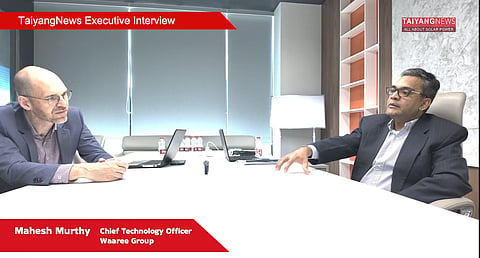
As part of its India Roadshow 2026, the TaiyangNews team visited Waaree Group’s factory complex. In this interview with TaiyangNews Managing Director Michael Schmela, Waaree Chief Technology Officer Mahesh Murthy discusses the company's expansion strategy, technology roadmap, international ambitions, and what India must do next to build a globally competitive solar manufacturing ecosystem.
TaiyangNews: India has been active in solar manufacturing for many years, but much of the global attention has come only recently as both the country's demand and manufacturing capacity have grown rapidly. Waaree is a market leader in India, and the company's journey to the top 10 has been an interesting and long one. Can you tell us about that journey?
Mahesh Murthy: Waaree was founded in 1989, but we entered the solar industry in 2007. Around five to six years ago, we had about 1 GW of solar module manufacturing capacity. Over the last five years, we have expanded rapidly as we have recognized the scale of the solar opportunity in India and positioned ourselves as one of the industry's leaders.
Government support has also played an important role in enabling the industry's growth, encouraging companies to establish domestic manufacturing for high-quality, high-performance solar modules.
TaiyangNews: Waaree now has more than 20 GW of module manufacturing capacity, which is remarkable. You started with modules before integrating upstream, but you have also expanded horizontally into multiple businesses. Can you tell us about the strategy behind that?
Mahesh Murthy: One of Waaree's founding principles is to dream big. We started as a solar module company, but as we scaled up, we realized that securing critical components would become increasingly important. Solar cells, for example, play a fundamental role in determining module performance. Once we reached sufficient scale, vertical integration became the logical next step.
The government has also been very supportive in creating an ecosystem where domestic cell manufacturing can flourish. Beyond cells, we see ingots and wafers as equally important. If you want to be a leader, you need greater control over the key components of high-performance modules.
But our vision extends well beyond vertical integration. As part of our publicly announced Waaree 2.0 roadmap, we are also strengthening our downstream businesses, including EPC and independent power production. At the same time, we are investing in other solar-related industries that are still underdeveloped in India. If we want to build a robust domestic solar ecosystem, we believe Waaree should play a leading role.
TaiyangNews: One thing that stands out is how comprehensive your strategy is. Some companies focus on aluminum frames, others on encapsulation, glass, or inverters. Waaree appears to be pursuing almost every part of the value chain.
Mahesh Murthy: That's part of our ambition. Many companies choose to specialize in one vertical and build deep expertise there. Our objective is different. We want to build a broad portfolio, but every business must also stand on its own commercially. Each must create value, be self-sustaining, and strengthen the overall Waaree ecosystem.
Ultimately, it is about bringing all these businesses together under one Waaree umbrella so we can continue to deliver value not only today but well into the future.
TaiyangNews: Moving from modules to cells, ingots, and wafers is a natural progression, as each product feeds into the next. But you've also entered businesses such as transformers, inverters, and glass. How do you ensure excellence across so many different industries?
Mahesh Murthy: Every one of these businesses has its own complexity. Module manufacturing is largely an automated assembly process, whereas cell manufacturing is driven by highly sophisticated chemical processes. Glass manufacturing is an entirely different discipline.
That is why we don't try to develop every capability from scratch internally. We bring in experts who already understand these industries. They can immediately establish operations while simultaneously building long-term capabilities within Waaree.
Transformers, electrical infrastructure, and every other component are equally critical. A weakness in any one of them can affect the entire solar ecosystem. Bringing these businesses under the Waaree umbrella allows us to influence quality, reliability, and long-term competitiveness across the value chain.
TaiyangNews: The transformer shortage showed how a seemingly small component could become a major bottleneck. But even for a company of Waaree's size, does manufacturing products like transformers at scale make commercial sense?
Mahesh Murthy: Scale is obviously important, and every business has to demonstrate long-term competitiveness. Not all of these businesses have been built organically. We have also pursued acquisitions where we believe a company has a strong long-term roadmap and can create value as part of the Waaree Group.
Some of these businesses are still relatively small today, but we believe that, with Waaree's support, they can become much stronger and remain competitive over the long term.
TaiyangNews: How much of these products are intended for your own captive use, and how much do you expect to supply to the wider market?
Mahesh Murthy: Much of it will naturally be consumed by our downstream businesses. Whether it’s BESS and solar or green hydrogen facilities, transformers are an integral part of these projects. Transformers, software, and other components are all essential parts of the solution.
Over time, market demand will determine whether we expand sales beyond our own projects. If there is significant demand for products like transformers outside the solar sector, that is certainly something we can evaluate.
For now, our priority is supporting the energy transition. We want to integrate these building blocks into comprehensive one-stop-shop solutions rather than simply supplying individual products.
TaiyangNews: So your objective is to become a complete solutions provider?
Mahesh Murthy: Absolutely. We want to lead India's energy transition, and that requires much more than supplying modules. Every application has different requirements. You need to understand the end use, identify the right building blocks, and execute projects successfully. Each individual business must excel on its own, but the real value comes from combining them into integrated solutions.
Our ambition is for Waaree to be recognized not simply as a module manufacturer, but as a company that leads the energy transition.
TaiyangNews: India is growing rapidly, but you've also expanded internationally, including establishing manufacturing in the United States. What is your strategy overseas?
Mahesh Murthy: Our decision to invest in the United States was made several years ago. The US is an important and attractive market, and we believed it was essential to establish a local manufacturing presence rather than relying entirely on exports from India. Waaree was probably the first company to decide to invest in the US market and start module manufacturing.
Being in the market also allows us to better understand customer requirements. The US differs from Europe and India in terms of product expectations, quality requirements, and applications. Rooftop customers, for example, place greater emphasis on aesthetics, while there could also be opportunities in areas such as building-integrated photovoltaics (BIPV).
We are still in the early stages, but establishing manufacturing there reflects our long-term commitment to serving the US market as a local company rather than simply as an exporter.
TaiyangNews: What products do you expect to supply in the US, and how do you plan to capture market share?
Mahesh Murthy: Today, we primarily supply utility-scale TOPCon modules. As we continue learning more about customer requirements, our product portfolio may evolve. Following our acquisition of Meyer Burger's assets, we also have the opportunity to supply HJT modules. If customers see value in HJT technology, we are well positioned to meet that demand.
TOPCon remains the dominant technology in India because it offers the right balance between cost and performance. However, different markets have different priorities, and we want to remain flexible enough to provide the technologies our customers need. If the US market or a segment develops a preference for HJT, for example, we need to be prepared for it.
TaiyangNews: How do you plan to bring the Meyer Burger factory back into operation?
Mahesh Murthy: Since the assets were transferred to Waaree, our first priority has been to assess the equipment's condition. We are evaluating what is already installed, what needs to be recommissioned, and what additional work is required before production can begin.
The equipment is quite different from what we operate in India, so a dedicated team is currently working through that process. It will still take several months for the facility to be ready, but our immediate focus is on thoroughly understanding the assets and returning them to operation.
TaiyangNews: Meyer Burger has resumed activity and recently announced a collaboration with Swift Solar. Is there any possibility of working with them?
Mahesh Murthy: At the moment, we are proceeding independently because the assets were acquired through the insolvency process. That said, Meyer Burger has built significant technical expertise over the years. Many of its scientists and engineers are now working elsewhere within the industry. As things evolve, we will see whether there are opportunities to engage with that talent in the future.
TaiyangNews: HJT still seems to attract considerable interest in the US. While it has not gained the same traction in many other regions, several players there continue to back the technology.
Mahesh Murthy: HJT has always been positioned as a premium technology. At the same time, TOPCon has continued to improve at an impressive pace. The performance gap between the two technologies has narrowed significantly while TOPCon has maintained a more attractive cost-performance ratio.
Another factor in HJT's favor is its suitability as the bottom cell for tandem architectures. Companies developing perovskite-silicon tandem technologies, including Swift Solar, are building on HJT for that reason.
We'll continue to monitor how both technologies evolve. The gap between HJT and TOPCon is much smaller today than it was a few years ago. We also need to see how back-contact (BC) technology evolves in terms of scale.
TaiyangNews: Sticking with technology, TOPCon is clearly the dominant technology today, and its progress has been remarkable. At the same time, we're seeing renewed interest in back-contact (BC) technologies, particularly as companies look for ways to differentiate themselves. How do you see Waaree's technology roadmap evolving?
Mahesh Murthy: That's an excellent question. If we look at India today, roughly 90% of manufacturing is based on TOPCon. However, there remains an efficiency gap between Indian manufacturers and leading Chinese producers. Closing that gap is one of our priorities.
Part of that comes through experience. As more Indian manufacturers produce TOPCon cells, they gain process knowledge and continuously improve quality and efficiency. TOPCon itself is also evolving, with newer cell architectures delivering higher efficiencies than earlier generations.
Our roadmap is therefore focused on continuously improving TOPCon while adopting the latest cell structures as they become commercially viable.
Beyond TOPCon, we remain open to supplying HJT modules wherever there is a clear customer value proposition. We also showcased BC modules at last year's REI Expo and expect to introduce low-volume BC modules later this year for customers who value higher efficiencies. That ensures we have solutions across multiple technologies rather than relying on a single platform.
Looking further ahead, perovskite tandem technology represents the next major transition for the industry. Like many others, we are working with leading developers to understand how Waaree should prepare for that future.
Much of today's tandem development still revolves around silicon bottom cells, whether TOPCon or HJT, with 4-terminal perovskite integration providing one of the most practical approaches. We see this as the next major leap in photovoltaic technology.
At the same time, our roadmap extends beyond efficiency improvements. It also focuses on value engineering, reducing silver consumption, moving toward silver-copper and eventually copper metallization, while ensuring reliability is not compromised.
So our R&D efforts have two objectives: supporting today's manufacturing through continuous improvements in cost and performance, while preparing for future technologies such as BC and tandem.
TaiyangNews: You mentioned R&D. Some Chinese companies invest an extraordinary share of their revenue in R&D. How do you see Waaree's approach?
Mahesh Murthy: Technology leadership requires much more than capital. It requires the right people, the right facilities, and the ability to translate research into commercial products.
Today, our R&D organization is closely integrated with manufacturing operations. That's important because research must remain connected to day-to-day production challenges. Otherwise, you risk losing practical relevance.
As we continue to grow, we also need to significantly expand our R&D capabilities. Every R&D investment must ultimately create value for the company, but there's no question that we need to strengthen our research organization over time.
We're already doing meaningful R&D, but we recognize that the next phase of growth requires a much larger effort.
TaiyangNews: India has outstanding universities, but the country still has relatively limited experience in solar manufacturing. How can India develop the skilled workforce needed for the industry's next phase?
Mahesh Murthy: India has an enormous advantage in terms of young engineering talent. Students graduate with strong technical backgrounds; they are comfortable working in English and highly ambitious. The challenge is helping them transition quickly into industry.
Companies like Waaree can bring interns into our factories and expose them to manufacturing, but that's only one part of the solution. We need much more structured training and a broader talent ecosystem that prepares graduates before they enter the industry.
Hands-on experience is especially important. Young engineers need opportunities to work directly with manufacturing equipment and understand how technology translates into production.
The other major opportunity is artificial intelligence (AI). The next generation needs to understand not only manufacturing but also where AI can improve productivity, automation, and decision-making. Their learning journey will be very different from what engineers experienced 20 years ago.
TaiyangNews: The Indian government has successfully created both demand and manufacturing capacity, but the industry is now facing significant overcapacity. Some even describe it as a bubble because so many companies have entered the sector. What needs to happen to ensure sustainable growth both for Waaree and the sector as a whole?
Mahesh Murthy: That's an excellent question. Over the past five years, success was largely measured by manufacturing capacity. Companies needed to build scale quickly because customer demand was growing rapidly, and scale also brought cost advantages. Today, however, we have reached a point where manufacturing capacity exceeds demand.
The next phase of growth will depend on solving a different challenge: dispatchable renewable power. Solar generates electricity for six to eight hours a day and remains weather-dependent. Energy storage is therefore the key to unlocking the next stage of solar deployment.
India has already recognized this at the national level, and companies like Waaree are investing accordingly. But we should avoid repeating the experience of solar manufacturing by relying heavily on imports. We need to localize battery manufacturing, cell production, cathode materials, and anode materials much earlier in the industry's development. Storage will create the next wave of opportunity for solar.
Beyond storage, success will increasingly depend on technology differentiation. Manufacturing capacity alone will no longer be enough. Companies will need better products, higher efficiencies, stronger quality, and meaningful innovation.
A module with 25% or 26% efficiency fundamentally changes project economics compared with one operating at 23%. The companies that continue to improve performance and differentiate themselves technologically will be the ones that succeed.
Government support through initiatives such as the Production Linked Incentive (PLI) scheme will continue to play an important role by encouraging domestic manufacturing while helping the industry grow responsibly.
TaiyangNews: One area where India still depends heavily on imports is manufacturing equipment. Most production lines continue to rely on equipment sourced from China, while some companies also procure equipment from Europe. What needs to happen for India to diversify its equipment supply chain?
Mahesh Murthy: The pace of capacity expansion in India has been so rapid that manufacturers naturally turned to established turnkey suppliers. Domestic equipment manufacturing simply hasn't had enough time to develop alongside the industry. Looking ahead, however, this presents an important opportunity.
If we consider Waaree's roadmap – and, more broadly, India's roadmap – we need to think beyond today's TOPCon production lines. The next generation of technologies, including tandem cells, will require a completely different set of manufacturing equipment, lasers, and production tools. This is where India should focus. Rather than trying to replicate existing TOPCon equipment, we should encourage domestic equipment manufacturers to develop the tools that will be needed three to five years from now.
Industry associations also have an important role to play. Equipment manufacturing remains one of India's weakest links, and companies need greater visibility before they are willing to invest. Today, many equipment manufacturers still see considerable risk because module manufacturers continue to rely on turnkey solutions from established suppliers.
We need to provide a clear technology roadmap so they understand what future manufacturing will require and where the opportunities lie. If Indian companies can deliver the required quality and reliability, I believe the industry will readily adopt domestic equipment.
TaiyangNews: How can Europe contribute to India's efforts to build a more resilient manufacturing ecosystem? India can certainly help Europe by supplying modules and cells, while Europe continues to have strong research institutes and considerable expertise in production equipment.
Mahesh Murthy: I believe we need deeper and more meaningful collaborations. It shouldn't stop at conferences or technical presentations. We need genuine partnerships where companies and research organizations work together to solve real technological challenges.
Take ISC Konstanz as an example. Organizations like that are pioneering technologies, and India doesn't yet have enough institutions with the long-term research capability needed to focus specifically on the future of photovoltaics.
India has excellent academic institutions, but Europe has decades of experience translating research into commercially viable technologies. That practical expertise is something we should leverage.
The ideal model is a true partnership where European research capabilities combine with India's growing manufacturing scale. Together, we can develop technologies in India that ultimately benefit global markets – including Europe itself.
TaiyangNews: Waaree's solar business will celebrate its 20th anniversary next year. When you reach that milestone, what do you hope the company will be celebrating?
Mahesh Murthy: First, it will be an opportunity to recognize everyone who has contributed to Waaree's journey over the past two decades. Building the company to where it is today has been a collective effort.
Personally, I've only been with Waaree for seven months, so I don't have the full history that many of my colleagues do. But it's clear that a tremendous number of people have helped shape the company.
At the same time, anniversaries are not only about looking back; they're also about looking ahead. As one of India's industry leaders, Waaree carries greater responsibility today than ever before. We have an opportunity to contribute not only to our own growth, but also to the country's broader energy transition and manufacturing ecosystem.
For me, that milestone should be both a celebration of what has been achieved and a reminder of our responsibility to continue leading, innovating, and helping shape the industry's future.
TaiyangNews: Thank you for the interview.
