

Solar trackers continue to strengthen their position in utility-scale PV, with global deployment reaching 112 GW in 2024. As adoption expands across regions, trackers are increasingly valued not only for higher energy yield but also for production-profile management and improved system performance.
Over the past few years, tracker innovation has accelerated across multiple dimensions. Structural configurations have diversified between 1P and 2P layouts. Row architecture has shifted toward longer spans and optimized torque tube designs. Drive systems have matured with improved slew drives, distributed motor architectures, and enhanced durability under dynamic wind loads. At the same time, stowing strategies have transformed into highly responsive, weather-driven control functions integrating wind sensing, structural validation, and predictive logic.
The intelligence layer of trackers is expanding rapidly. Today’s tracker controllers do far more than simply follow the sun. They are designed to respond to real site conditions by adjusting tilt during diffuse light, reducing structural stress during high winds, and shifting into protective stow positions. Overall, the direction is clear: trackers are becoming smarter and more resilient, balancing higher energy yield with improved reliability and cost efficiency.
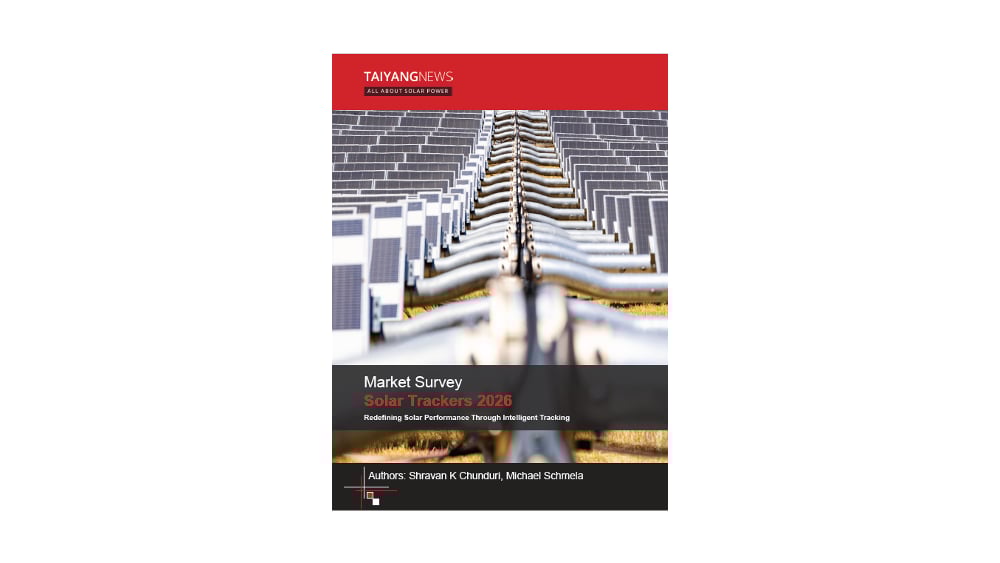
In this 4th edition of the TaiyangNews Solar Trackers Market Survey, we provide a comprehensive overview of market developments, structural configurations, drive architectures, stowing strategies, terrain adaptation, and cost trends. The report also covers dual-axis trackers (DAT) and tilted tracker designs, alongside mainstream HSAT platforms. In addition to covering the key trends, the survey also includes a detailed product description and tables containing the key technical specifications of products from each survey participant. The survey received responses from 17 companies, covering 32 tracker products, including most of the segment’s leading suppliers.