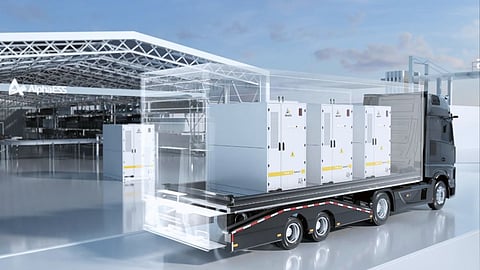

AlphaESS has launched its STORION-LC 836 series BESS for utility-scale applications
Compared to a conventional container-based system, it combines multiple containers with a front-end electrical interface in a cluster
It is designed to support ancillary services, such as peak-shaving and energy arbitrage
Solar-plus-storage solutions provider AlphaESS has introduced a cabinet-based battery energy storage system (BESS), STORION-LC 836, designed for utility-scale applications.
The product’s key features include a modular and scalable design, ease of deployment & installation, and fire-safety features.
Unlike the conventional single-container-based design (typically a 40-ft container), it offers a smaller cabinet with a footprint of 1,450 × 2,480 × 2,435 mm (W × D × H). For a multi-cabinet-based site layout design, these smaller and 7.5-tonne cabinets can be handled and transported easily. After reaching the site, installers place these units in a side-by-side or back-to-back configuration and connect via a front-side electrical interface. Without providing figures, AlphaESS states that this product design and installation procedure reduces on-site wiring effort and shortens installation lead time.
On the performance side, the cabinet is equipped with 4 LFP battery units, each rated at 104 kWh. With a cumulative capacity of 835.9 kWh, it delivers a power output of up to 417 kW at a charging/discharging rate of 0.5C. This capacity can be further scaled up to 6.7 MWh by connecting 8 units in parallel, forming a system cluster. This upscaling can be accomplished in phases, aligning with the project’s renewable energy build-out and grid connectivity timelines.
In terms of operational efficiency and safety, its internal temperature is controlled by an integrated liquid-cooling mechanism across battery units. For outdoor operations, each battery unit features an IP67-rated enclosure that resists dust and water ingress. In addition, the system cabinet has an ingress protection level of IP55. This operational mechanism and system design enable the system to operate in an outdoor temperature range of -30°C to +50°C, without derating.
On the safety side, the BESS has multi-layer safety features and is aligned with the NFPA 855 framework. It monitors and tracks the status of temperature, smoke, and gas, by built-in sensors, whose signals are processed via its battery management system (BMS) in real-time. In the event of abnormalities, it activates its aerosol and water-based fire suppression system. In addition to extinguishing the fire, the system’s internal pressure is maintained within safe limits by pressure relief valves and ventilation functions. According to the company, these features help limit fire propagation, support safer installations, and system-level risk management, in line with the NFPA 855 framework.
From an application standpoint, with a charge/discharge rate of 0.5, this system is suitable for peak shaving and energy arbitrage.

