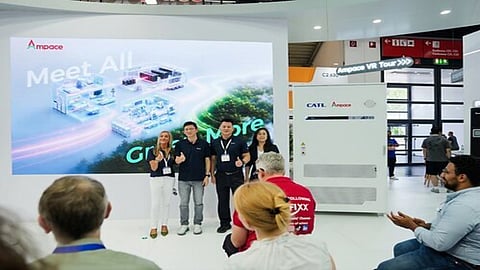

Ampace promoted its UniC AG440 series C&I ESS for Europe’s industrial parks and PV + storage + charging stations
According to the company, it can operate at a very low temperature of -25°C without any auxiliary heating
The company also launched its PR-S3 series residential ESS with FrostCore Tech technology that ensures stable operation at a temperature of -20°C
Xiamen-based Li-ion battery energy storage system (ESS) provider Ampace Technology Limited unveiled 2 ESS models at Intersolar Europe: UniC AG440 and PR-S3 Elite. According to the company, these products were developed keeping Europe’s extreme weather conditions in view.
The UniC AG440 commercial & industrial (C&I) ESS is equipped with CATL-made battery packs and boasts a storage capacity of up to 440 kWh. Designed for large industrial parks, PV + storage + charging stations, and high-energy-consuming enterprises, it supports up to 45 units in parallel (electrical) with a cumulative capacity of 20 MWh. According to the company, users can choose between a 2 - or 4-hour configuration for energy coverage. It can operate under extreme weather conditions at temperatures as low as -25°C without derating, freezing of the circulating liquid coolant, or auxiliary heating. Ampace claims the system can deliver up to 50% higher energy density (kWh/m²) within a footprint up to 50% smaller than 200 kWh alternatives.
For residential applications, the company’s latest PR-S3 Elite series ESS features batteries with a guaranteed life (charging/discharging) of 15,000 cycles. Ampace claims its proprietary technology, FrostCore Tech, helps to overcome issues with the mobility of Li-ions at very low temperatures of -20°C.

