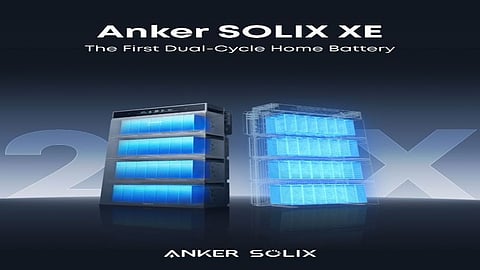

Anker SOLIX has launched its latest XE series home battery system during SEC 2026
It comprises 2 battery units, each with up to 7 kWh capacity, and a 5 kW inverter in a single enclosure
The home battery product eliminates the use of CTs and external communication wiring with its wireless metering system
During the Smart Energy Conference & Exhibition (SEC), Anker SOLIX, a provider of balcony PV and storage systems, unveiled its XE home battery. The company says the product is tailor-made for Australia’s latest tiered rebate structure.
Anker SOLIX characterizes the country’s residential storage market as at a ‘critical turning point’. This market pivot is primarily driven by the implementation of the usable battery capacity-based rebate distribution under the federal Cheaper Home Batteries Program, starting May 1, 2026. It says that a residential prosumer with a usable battery capacity of up to 14 kWh will be eligible for the highest rebate slot.
This new product comprises 2 vertically connected battery units, each with up to 7 kWh capacity – in the ‘sweet spot’ of the rebate. In addition, featuring 100% Depth of Discharge (DOD), each battery can deliver full rated capacity without any hidden reserve. The battery stack, when coupled with a 5 kW hybrid inverter, forms the 5 kW/14 kWh energy storage system (ESS). The company stated that these attributes help prosumers install and use 14 kWh storage, without paying for any redundant capacity.
Unlike conventional home storage systems, typically developed to provide emergency backup or maximize self-consumption, this system is built for daily dual-cycle (charging/discharging). Equipped with 314 Ah LFP cells, this battery stack is engineered for up to 10,000 cycles, equivalent to a lifespan of up to 15 years. According to the company, it is fully charged by the near-free grid electricity, typically from abundant midday solar generation, in line with the country’s Solar Sharer Policy. This stored energy is discharged during peak evening hours, then recharged overnight using off-peak grid electricity. At last, the dual-cycle is finished by morning peak-hour discharge. This, in turn, maximizes the value of excess solar energy during midday, rather than wasting it.
Addressing the country’s high labor and commissioning costs, the company has combined the battery stacks and an inverter in a unibody enclosure. It also eliminates the use of current transformers (CTs) and external communication cables by adopting a wireless metering mechanism. Anker SOLIX claims this storage system reduces installation time to 2 hours compared to 4 hours for standard split systems, while avoiding wiring errors by up to 90%. In addition to user-friendly installations, its compatibility with both AC and DC-coupled configurations enables its use in retrofit (AC) and greenfield (DC) projects.
Pointing to the supply-demand delta of home battery attachment rate at 95% out of 4 million solar roofs, General Manager APAC, Symons Xie, suggested: “…households need smarter, not just bigger, storage.” He added, “The XE’s ‘right-sized' design rejects blind capacity-stacking, converting these challenges directly into margins for installers and ROI for homeowners.”
This product is currently undergoing certification by the Clean Energy Council (CEC), with commercial availability expected in August 2026.

