
CATL’s latest TENER series SIB-based BESS, in combination with external PCSs, can be configured for a backup of 1, 2, 4, 6, and 8 hours
It has a lifetime of up to 15,000 cycles, representing a performance lifespan of 25 to 30 years
This product is expected to be commercially available in China in September 2026, while global deliveries are scheduled to start in June 2027
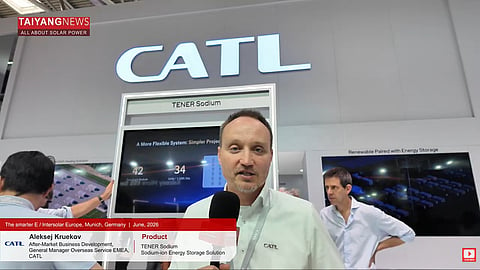
The common pain points for utility storage consumers are flexibility, stability, and system availability. China-based battery and technology company CATL launched its latest TENER series of sodium-ion chemistry-based battery energy storage systems (BESS) at Intersolar Europe 2026. In an interview with TaiyangNews at the event, Aleksej Kreukov, CATL’s After-Market Business Development and General Manager of Overseas Service in EMEA, explained how this product addresses these ‘real-world problems’.
Equipped with multiple sodium-ion batteries (SIB) within a container, each unit has a storage capacity of up to 30 MWh. For a 1 GWh standalone utility storage project, up to 34 units, each weighing up to 42 tons, can be coupled with external power conditioning systems (PCS). This AC-coupled system architecture decouples the power block from the energy segment and supports different PCS capacities as required by the project, with backup durations configurable to 1, 2, 4, 6, or 8 hours.
Compared to conventional lithium-iron-phosphate (LFP)-based batteries, it can operate at higher temperatures without derating, making it suitable for ‘areas with severe temperature conditions’. Kreukov continued, “It could be the Nordics with -20°C or be South Africa, Africa, or the Middle East with extreme highs of up to 45°C.”
On the power performance side, sodium-ion technology offers a wider DC voltage range than its LFP counterparts, delivering power gains under low-light or -charge conditions. However, this low voltage causes the DC busbar voltage to fall outside the rated PCS input voltage range, resulting in power loss. The company addresses this by incorporating a bidirectional DC voltage regulation system that automatically boosts the busbar voltage during low-voltage conditions. According to the company’s press release, it results in an additional round-trip efficiency (RTE) of up to 2% compared to LFP peers. With respect to LFP batteries’ long, flat voltage curve (battery terminal voltage vs. state-of-charge, or SoC), its slope-based voltage curve helps measure real-time SoC more accurately, says Kreukov. Therefore, with a reduced risk of overcharging, its battery management system (BMS) offers up to a 20% additional safety margin during operation, providing leeway to detect and correct abnormal conditions.
From a system availability perspective, the BESS’s modular architecture enables localized fault isolation by dismantling or disconnecting faulty units, facilitating continuous system operation. Broadly, this system, with a lifetime of up to 15,000 cycles, offers a guaranteed performance range of 25 to 30 years, making it a bankable storage solution, Kreukov added. Furthermore, sodium is abundantly available, unlike lithium, leading to lower costs.
The company expects to begin domestic deliveries by September 2026, with cumulative shipments reaching 1 GWh by the end of 2026. Global shipments are expected to begin in June 2027.

