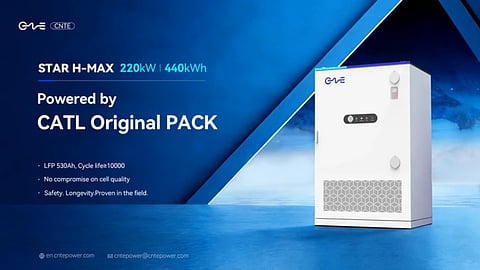

CNTE promoted its 220 kW/440 kWh C&I ESS at the show
The company says that it supports up to 2 hours of backup, which can be increased to up to 4 hours in specific application scenarios
The ESS’s thermal regulation is based on a circulating liquid coolant, and the batteries have a guaranteed life of up to 10,000 cycles
Contemporary Nebula Technology Energy (CNTE), an energy storage system (ESS) provider invested in by CATL, showcased its latest products at Intersolar Europe 2026, targeting commercial & industrial (C&I) and utility applications.
The company promoted its cabinet-based STAR-H MAX series ESS for the C&I segment. Measuring 1,400 × 1,450 × 2,150 mm (W × D × H), it houses storage, a power conversion system (PCS), an energy management system (EMS), and a battery management system (BMS) within a single platform. From a storage perspective, it is equipped with CATL’s 530 Ah LFP cell-based battery packs, with a cumulative capacity of 440 kWh. Its volumetric energy density is 101 kWh/L. It features a 220 kW bidirectional PCS, which makes a 220 kW/440 kWh C&I ESS platform. In the event of a grid outage, it can discharge at a 0.5C rate, with a corresponding 220 kW (3-phase) full-load power, for approximately 2 hours or until the battery cut-off voltage is reached. For charging through the grid, it also maintains the same C-rate. This rate can be configured to 0.25P, which restricts the PCS capacity to up to 110 kW for approximately 4 hours or until the cut-off voltage limit is reached. The company states that this flexibility enables end-users to choose between high-power backup for short durations and longer backup periods at reduced power output. The battery stack has a life of up to 10,000 cycles. This standalone ESS platform’s capacity can be expanded to 2.2 MW/4.4 MWh by connecting 10 units in parallel, making it suitable for factories, large office buildings, or industrial parks.
In addition to supporting emergency backup, it can smooth the overshoots of the real-time load profile compared to the scheduled one during costly peak hours. In addition to these behind-the-meter (BTM) functions, it participates in grid-interactive energy management services, including fast frequency support within 250 ms. This quick response time enables the system to participate in frequency containment reserve (FCR) and automatic and manual frequency restoration reserve (aFRR & mFRR) applications.
In terms of operational efficacy, the storage component features a liquid-cooled thermal management system. During the above-mentioned complex operations, a circulating liquid coolant is pumped across the surface of the batteries, where it absorbs the heat. This warm coolant is then channeled through a chiller or heat exchanger to cool itself and be reused. The company notes that this round-the-clock thermal regulation results in an average cell-to-cell temperature variance within 3°C. The system is engineered to operate satisfactorily in Europe’s freezing temperatures down to -25°C without derating.
For safety, it features real-time insulation resistance (IR) monitoring, a multi-layered fire protection system against thermal runaway, and an early-warning fire alarm system.

