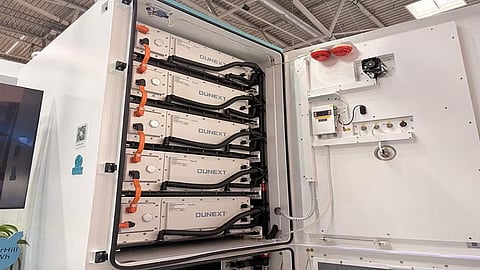

Dunext launched its latest PowerHill-P125-261 kWh-S2 series 125 kW/261 kWh 3-phase C&I ESS at the show
The company says that the system’s capacity can be scaled up by connecting 10 units in parallel
Its cell-to-cell operational temperature delta can be restricted to within 2.5°C by a circulating liquid medium
Dunext, a PV and energy storage system (ESS) provider, expanded its PowerHill ESS portfolio by launching the PowerHill-P125-261 kWh-S2 at Intersolar Europe 2026 for commercial & industrial (C&I) prosumers.
This ESS, equipped with 5 battery packs, each featuring 314 Ah lithium-iron-phosphate (LFP) battery cells in a 1P52S configuration, offers a rated capacity (charging/discharging) of 261 kWh. Compared to the company’s existing liquid-cooled 60 kW/215 kWh and 105 kW/233 kWh PowerHill series ESSs, it can deliver or store up to 261 kWh of energy at 125 kW full-load (3-phase) power for up to 2 hours at a rate of 0.5C. It switches to off-grid mode once the grid goes out and delivers an emergency backup of up to 125 kW for 2 hours, enabling uninterrupted C&I operations. It also helps C&I prosumers optimize electricity bills by discharging up to 261 kWh of stored energy at 125 kW within time slots that coincide with high grid electricity tariffs and power demand overshooting, which is called peak shaving. The ESS charges itself during low-demand and low-tariff periods, a practice called valley filling. Also, it can be co-located with an existing PV plant and coupled with it for integration of flexible renewable energy. In addition to these behind-the-meter operational functions, it can be used for multiple grid ancillary services. Its capacity can be expanded to 1.25 MW/2.6 MWh by connecting 10 ESSs in parallel.
These complex operations, which are monitored and controlled by an integrated energy management system (EMS), generate internal heating. According to the company, its battery cell-to-cell temperature delta is kept within 2.5°C by a circulating liquid medium. The ESS enclosure integrates temperature and smoke sensors to quickly detect fire ignition caused by thermal runaway. It also features an aerosol-based fire suppression system as the next level of defense. The company noted that the ESS is designed to operate within a temperature range of -25 to +55°C.

