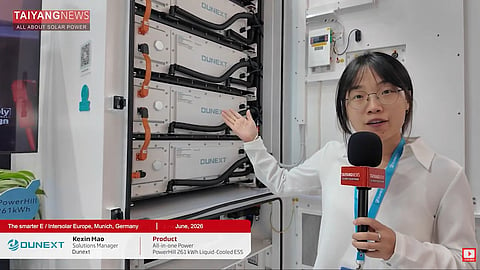

Dunext launched its latest PowerHill-P125-261kWh-S2 series 125 kW/261 kWh 3-phase C&I ESS at Intersolar Europe
Its built-in EMS enables users to perform real-time behind-the-meter operations, such as peak shaving, valley filling, and adjusting to dynamic electricity tariffs
The company also displayed its PCC unit, which, when integrated with the ESS, facilitates emergency backup operation within 20 ms of a grid outage
Volatile electricity tariffs at commercial scale and energy insecurity are driving Europe’s commercial & industrial (C&I) prosumers to increasingly focus on energy storage solutions. On the operations side, users are trying to hit the bullseye of balancing reliable, cost-effective, uninterrupted operation while also generating passive revenue.
Dunext, a C&I PV plus storage system provider, addressed these expectations with its latest showcase, PowerHill-P125-261 kWh-S2, at Intersolar Europe 2026. The company’s Solution Manager, Kexin Mao, briefly highlighted the product’s key features to the TaiyangNews representatives on a booth visit.
Mao emphasized the auto-replenishment function of this energy storage system’s (ESS) liquid-cooling unit. Its built-in refill tank automatically tops up the liquid coolant in line with changes in the return water pressure of the closed-loop cooling cycle. This feature eliminates manual coolant top-ups. Mao claimed that this coolant can perform for up to 10 years without replacement, reducing operation and maintenance (O&M) costs.
Equipped with 5 lithium-iron-phosphate (LFP) battery packs, each with a capacity of 52.25 kWh, this ESS can store or deliver up to 261 kWh of energy at 125 kW of full-load power. It places a built-in 125 kW power conversion system (PCS) at the bottom of its cabinet and works as a bidirectional inverter in an AC-coupled configuration. For capacity expansion, it can be connected with up to 10 ESSs in parallel, with a cumulative capacity of 1.25 MW/2.61 MWh.
For the rated 2-hour backup, this storage system needs to be integrated with an external PCC cabinet. It switches the ESS to off-grid mode using the built-in static transfer switch (STS) within 20 ms of a grid outage, enabling continuous C&I operations. This small cabinet can support up to 3 ESS units at a time, Mao noted.
In terms of real-time behind-the-meter functions, it incorporates an energy management system (EMS), comprising a controller and embedded software. Mao highlighted the displayed controller, elaborating on its default functions, including peak-shaving, PV self-consumption, and adjusting charging/discharging according to dynamic electricity tariffs. Altogether, they contribute to the user’s cost-effective power consumption, albeit passively, says Mao.

