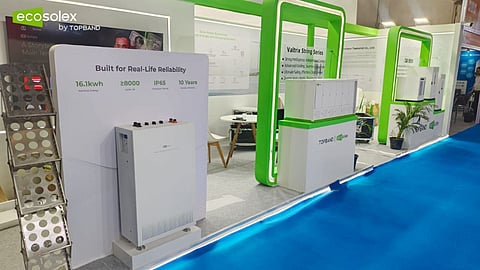

Ecosolex introduced its Opti L16 ESS, with a rated capacity of 16.1 kWh that can be expanded to up to 515.2 kWh, at the show
The company also showcased its Flexo 200, M125G261A, and Valtrix String 3.0 ESSs for C&I applications
All showcased models use liquid-based thermal regulation
Ecosolex, the energy storage system (ESS) arm of China-based Topband New Energy, displayed its product lineup at The Battery Show India 2026 for residential and commercial & industrial (C&I) applications.
Residential ESSs
The company promoted its Opti L16 residential ESS, aiming at flexible installation and capacity expansion. Measuring 500 × 250 × 925 mm (W × D × H), it includes a lithium-iron-phosphate (LFP) battery stack with a total capacity of 16.1 kWh. It has a nominal capacity of 314 Ah and a rated voltage of 51.2 V DC, with an operating voltage range of 46.4 to 56 V DC. The product datasheet specifies a nominal charging/discharging power of 7.680 kW at 150 A. However, its rated maximum charging power of 10.24 kW is slightly lower than the rated maximum discharging power of 11.78 kW. The ESS shares the same operating temperature range of -20 to +55°C for charging and discharging modes. It has a guaranteed life of ≥8,000 cycles under testing conditions of 25°C, at a 0.5C rate, 90% DOD, and 70% EOL (End of Life). For installation flexibility, it supports floor- or wall-mounted installations as a stationary system. On demand, it can be fitted with four landing wheels for a movable system. For users with growing domestic loads, it supports up to 32 units connected in parallel, with a staggered total capacity of 515.2 kWh.
Ecosolex also presented its Flexo 50 Pro ESS with built-in 53.7 kWh storage capacity, a power conversion system (PCS), and an energy management system (EMS) in a larger 1,020 × 1,200 × 1,400 mm cabinet. It uses 100 Ah LFP batteries, with a higher nominal voltage of 537 V and a wider operating voltage range of 470.4 to 613.2 V. Unlike the model above, it supports up to 40 kW PV capacity via three built-in MPPTs, each rated at a maximum current of 40 A and a voltage range of 150 to 850 V. When paired with the 400 V AC grid via a 30 kW PCS, the system can charge its storage section from either PV or the grid source (PV source remains the priority). This helps users maximize PV self-consumption. The ESS switches to backup mode within ≤10 ms of a grid outage and delivers a full-load power output of 30 kW at 400 V AC to critical loads, reducing reliance on a diesel generator (DG). The product datasheet specifies an operating temperature range of -20 to +55°C, an IP55 rating, and an operating noise level of <75 dB.
C&I ESSs
For C&I applications, the company showcased three ESSs: Flexo 200, M125G261A, and Valtrix String 3.0.
The first model uses a 1,000 × 1,350 × 1,850 mm cabinet to place up to four LFP battery units, each rated at 314 Ah and 52.2 kWh, for a total capacity of 208.96 kWh. It adds a 100 kW hybrid inverter externally to discharge the stored capacity to the connected loads at 0.5C. According to the product datasheet, it is rated for ≥6,000 charge/discharge cycles at 25°C, 0.5C, and 80% EOL over its lifespan.
M125G261A is housed in a slightly taller cabinet (1,000 × 1,350 × 2,250), offering a 53 kWh higher storage capacity compared to 208.96 kWh, using 314 Ah LFP battery units. It combines a 125 kW PCS, an EMS, and a battery management system (BMS) within the cabinet, rather than employing an external inverter. The product datasheet specifies a charging/discharging switching time of <100 ms and a full-load output current of 180 A at 400 V AC. It has a life of ≥6,000 cycles.
The largest among the three, Valtrix String 3.0, is housed in a 6,058 × 2,896 × 2,438 mm container and has a rated storage capacity of 3.134 MWh. It combines 12 modular LFP battery clusters, each rated at 261 kWh, in the container. It places six clusters on each side (front and rear) of the container. Built-in PCSs, placed beneath individual battery modules, enable grid-pairing at 400 V AC. The system has a nominal C-rate of ≤0.5C, an IP55 rating, and a maximum system round-trip efficiency (RTE) of ≥90%. It targets large commercial and industrial-scale projects.
All C&I ESSs employ liquid cooling for thermal regulation.
TaiyangNews has recently published its "Balance of System (BoS) Components 2026" report, featuring inverters, storage and technology trends presented at SNEC and Intersolar Europe 2026.
