
Envision launched its Gen8 4.X series utility BESS for long-duration storage of between 8 and 16 hours
Among the displayed products was the company’s SST for an economical and space-saving AIDC power distribution
The company also promoted its 385 kW PV string inverter with grid-forming capability, which works with plant-level controls and BESS to provide coordinated frequency response and smooth changes in power output
As variable renewable energy accounts for a growing share of electricity generation, co-located battery energy storage systems are becoming increasingly important for grid stability. At the same time, grid-code requirements are evolving, increasing the demand for advanced capabilities such as grid-forming control in battery systems and inverters.
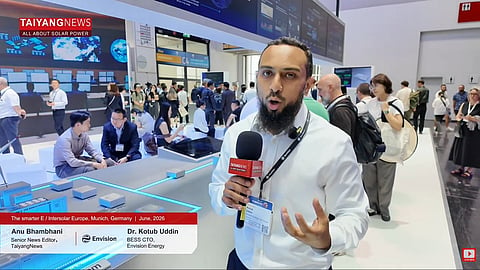
Speaking to TaiyangNews at Intersolar Europe 2026, Envision Energy’s BESS CTO, Kotub Uddin, described how the company’s latest products address these requirements. Emphasizing the ‘breadth and depth’ of the company’s portfolio, Uddin said Envision develops core components in-house, builds standalone wind, solar and storage products, and integrates them – using its own controls, EMS and SCADA – into complete grid-scale hybrid power systems.
On the inverter side, the company showcased its utility-scale string inverter with a full-load power output of 385 kW (3-phase). Among the product’s key features, he highlighted 8 built-in MPPT channels, arc-fault circuit-interrupter (AFCI) safety functions, and grid-forming capability. Unlike the central inverter-based sites, its distributed MPPT design supports more flexible plant operation and helps limit the impact of faults to individual PV arrays. When integrated with AC-coupled BESS and coordinated through plant-level controls, the string inverter supports faster grid response and smoother ramp-rate control in line with grid operator requirements. By combining in-house power electronics with real-time coordination, Envision enables integrated solar-storage operation and millisecond-level coordination from module to plant level, helping improve system performance, reliability and project economics.
The company’s latest containerized BESS was also in focus. The Gen 8 4.X MWh Long-Duration Energy Storage System is equipped with Envision’s own cells and silicon carbide (SiC)-based string power conversion systems (PCSs). In terms of power performance, the system can provide 8 to 16 hours of energy storage and deliver a round-trip efficiency (RTE) of up to 91%. It also improves the accuracy of real-time battery state-of-charge (SoC) measurements by 3 percentage points, says Uddin. For grid-forming applications, the system can deliver up to 250% overload capability to support stable performance during transient grid conditions. The company attributes this system oversizing to its distributed AC-block configuration and SiC-based power devices, enabling a higher switching frequency than centralized PCS-based DC-block peers. At installation, it reduces footprint by up to 30% compared to conventional 5-7 MWh counterparts, thereby optimizing balance-of-plant (BoP) costs. This system has a 25-year lifecycle.
These products are monitored and controlled by grid operators via dedicated and hybrid power control centers (PPCs). Uddin claimed that this integrated communication with grid operators helps plants comply more accurately with grid operators’ ramp-rate requirements.
For AIDC applications, Uddin set the context by explaining the latest trend in battery storage and power distribution. Changing GPU workloads are pushing rack power densities from kW to MW-scale, which demands higher switching speeds, efficiency, and reliability. In contrast, the AIDC power distribution system is not scaling as per demand, Uddin noted. Drawing experience from the company’s Ulanqab, China-based GW-scale AIDC energy infrastructure, which is 100% RE-powered, the company has launched its 2.5 MW solid-state transformer (SST). Unlike conventional multistage architectures, which use separate voltage-transformation and AC/DC-conversion stages, the SST accepts 10 kV or 13.8 kV AC input and supplies an 800 V DC output. Uddin emphasized that it integrates voltage transformation and power conversion into a single digitally controlled power electronics platform, supporting an AIDC power ecosystem designed to deliver system availability of up to 99.999%. He added that it reduces electrical infrastructure footprint by up to 50%, facilitating ‘more GPUs into the same space’. On the other side, these GPUs will be directly coupled with the company’s 800 V DC AIDC BESS. Its LFP-based storage system supports backup power and multi-hour energy shifting, providing up to 2.5 MW for durations of 2 hours or more. Uddin said that the system’s sodium-ion solution charges and discharges within minutes to smooth rapid AI load fluctuations. Reducing reliance on high-tariff electricity helps the AIDC operators to issue cheaper tokens. In terms of token/kW, the company targets or delivers more than a 30% improvement, claimed Uddin.

