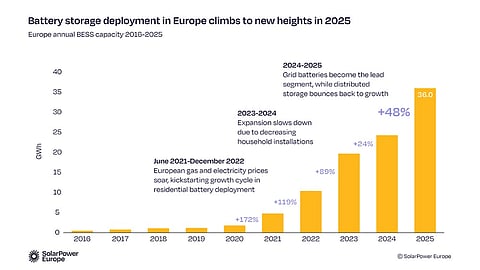


Europe installed a record 36 GWh of battery storage in 2025, taking total operational capacity above 100 GWh for the first time
Utility-scale batteries became the largest annual market segment, accounting for more than half of new installations
SolarPower Europe forecasts annual installations to reach 138 GWh by 2030, but says stronger policy support is needed to meet the EU’s storage ambitions
Europe installed a record 36 GWh of battery energy storage systems in 2025 – including 27 GWh in EU-27 – bringing its operational battery fleet above 100 GWh for the first time, according to SolarPower Europe's latest market outlook. The report found that utility-scale projects accounted for more than half of annual deployments, signaling a shift in the region's storage market.
Last year was the 12th straight year of growth for Europe’s battery energy storage market, according to SPE’s European Battery Market Outlook 2026-2030, launched at ees Europe, The smarter E Europe 2026.
The market grew 48% year-on-year (YoY), rebounding from a slower 2024 and entering what the industry association described as a new phase of expansion led by utility-scale battery projects.
“Battery storage is becoming a strategic asset for Europe’s resilience, competitiveness and energy sovereignty,” said Michael Schmela, Executive Advisor and Director of Market Intelligence at SolarPower Europe and TaiyangNews Managing Director. He noted that batteries are increasingly moving from being viewed as a supporting technology to becoming a core component of Europe’s energy transition.
For the first time, SPE says utility-scale projects accounted for more than half of annual battery installations in Europe. The segment’s growth was supported by increasing demand for system flexibility, stronger revenue-stacking opportunities, falling technology costs, growing investor confidence, and the rapid expansion of hybrid solar-plus-storage projects.
While residential storage remains the largest segment of Europe’s cumulative battery fleet, its market share has continued to decline. Utility-scale batteries are expected to overtake residential storage as the largest installed segment as early as 2026.
The association underscores that the shift reflects broader challenges facing European power systems, including rising curtailment of renewable energy, grid congestion, and declining solar capture prices, all of which are increasing the need for energy storage.
Germany, the UK, and Italy retained their positions as Europe’s three largest battery storage markets in 2025. However, the report highlighted growing geographical diversification, with Ukraine and Bulgaria entering the top 5 after each added nearly 3 GWh of battery capacity during the year.
Ukraine’s emergence was particularly notable as battery storage, alongside solar, became an important tool for maintaining grid stability and energy security following extensive damage to its power infrastructure caused by the war. Bulgaria, meanwhile, recorded one of the fastest growth rates in Europe following successful utility-scale funding programs.
The top 5 markets accounted for 62% of all installations in 2025, down from nearly 80% a year earlier, indicating broader adoption of battery storage across Europe.
The association expects Europe’s battery storage market to continue expanding rapidly over the remainder of the decade. Annual installations are projected to exceed 50 GWh in 2026, with a 44% YoY increase led by utility-scale installations, before rising to 138 GWh by 2030 under the medium scenario, representing a 4-fold increase over 2025 levels.
Total installed battery capacity across Europe is forecast to reach 582 GWh by the end of the decade – a 6-fold increase from over 100 GWh today, while the EU-27 alone is expected to reach around 470 GWh.
By 2030, the European Commission targets 200 GW of energy storage capacity for the EU under AccelerateEU, up from the currently installed 55 GW. Despite the strong growth outlook, SolarPower Europe said Europe remains below the level of battery deployment required to fully support a highly renewable and electrified energy system.
Walburga Hemetsberger, SolarPower Europe CEO, stressed, “Europe’s battery market is moving in the right direction, but we are not yet where we need to be. The EU has rightly recognised this with its 200 GW storage target for 2030, but delivering on that ambition will require much faster progress.”
The report calls for a dedicated EU Battery Storage Action Plan focused on streamlining permitting and grid connections, ensuring full market access for storage, removing discriminatory network charges such as double charging, creating stable investment frameworks, and improving access to financing.
According to SolarPower Europe, faster deployment of battery storage will be essential to reduce fossil fuel dependence, improve energy security, and enable the continued growth of renewable energy across the continent.
The report is available for free download on SPE’s website.
