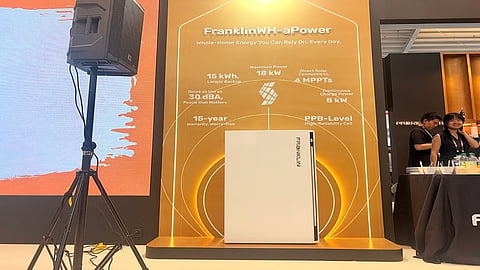

FranklinWH promoted its aPower series AC-coupled 15 kWh home ESS that integrates solar, EVs, and DG via a central controller, aGate
Its storage capacity can be expanded to 225 kWh by connecting 15 units in parallel through the controller
Apart from maximizing self-consumption, the controller supports ToU tariff-based operation and participation in local VPPs, contributing to grid stability, albeit passively
FranklinWH Energy Storage Inc., a US-based residential energy storage system (ESS) provider, showcased its aPower series ESS, along with the aGate central energy controller and software solutions, at Intersolar Europe 2026.
In Europe, rising electricity costs and energy insecurity are driving the integration of solar, electric vehicles (EVs), and home heating with storage to maximize the use of clean power. FranklinWH addresses this need with aPower. Equipped with lithium-iron-phosphate (LFP) battery packs, it can connect directly to a rooftop PV array via four built-in MPPTs. With a storage capacity of 15 kWh, this direct connection eliminates an intermediate PV inverter and maximizes solar harvesting. Its battery stacks have a continuous charging power of 8 kW. With a built-in battery inverter, this AC-coupled ESS is designed to deliver a maximum power output (single-phase) of 18 kW for a short duration. Additionally, it can deliver continuous emergency backup power during a grid outage.
Its storage capacity can be expanded to 225 kWh by connecting 15 units in parallel via the company’s aGate central energy controller, thereby extending its application beyond home ESS. It can be charged from multiple energy sources, including solar, further reducing reliance on costly grid electricity. Users can plug their EVs into the controller to draw energy from parked vehicles' batteries (V2L) to charge the ESS. For extended backup, the controller also supports a standby or portable diesel generator (DG), which helps charge the batteries during low solar output or when storage capacity is depleted.
In addition to maximizing self-consumption, this system, as part of distributed energy resources (DER), can passively contribute to grid flexibility. Its real-time energy flow via aGate can be monitored and controlled by the FranklinWH app installed on the user’s device. The app can be used to schedule home load usage by load type via an add-on feature called the Smart Circuits Module. The controller can also schedule battery charging and discharging according to dynamic time-of-use (ToU) tariffs to optimize electricity costs. Additionally, it supports the system to participate in regional utility-led virtual power plant (VPP) programs and generate passive income by dispatching clean power on demand to grid operators. The company has revealed its intentions to enter the European market, banking on its experience from 25 VPPs and demand response programs in the US.
This product is scheduled to be commercially available in 2027 across Europe.

