

Global annual battery storage installations crossed the 100 GW mark for the first time in 2025, according to Wood Mackenzie
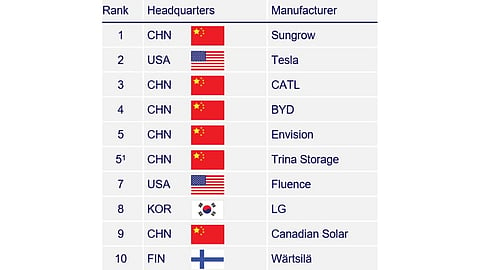
Sungrow led Wood Mackenzie’s inaugural global BESS integrator ranking, ahead of Tesla and CATL
Analysts list project execution, technology performance and long-term support emerging as key factors in supplier selection
The global battery energy storage market crossed a new threshold in 2025, with annual installations surpassing 100 GW for the first time, according to a new Wood Mackenzie analysis.
The market research firm's first Global Battery Energy Storage System (BESS) Integrator Comprehensive Ranking reflects a growing buyer focus on suppliers with strong project execution and long-term service capabilities across the project lifecycle.
Chinese players dominate the Wood Mackenzie ranking with Sungrow at the top, followed by Tesla (US) and CATL (China). BYD (China) ranked 4th, while Envision and Trina Storage (both from China) jointly ranked 5th.
Fluence (US), LG (South Korea), Canadian Solar (China), and Wärtsilä (Finland) rounded out the global top 10 last year.
Wood Mackenzie says its ranking covers suppliers of AC-integrated BESS products that combine batteries, power conversion systems (PCS), battery management systems (BMS), thermal management, and controls into a single factory-assembled, AC-connected solution.
Analysts explain that as battery storage takes on a larger role in power systems, project buyers are also broadening the criteria they use to select system suppliers.
For its assessment, Wood Mackenzie evaluated suppliers against 10 criteria, including technology maturity, research and development (R&D), safety, vertical integration, supply chain resilience, environmental, social and governance (ESG) performance, and financial strength.
The methodology, they explain, reflects the wider range of factors now being considered by utilities, independent power producers, and project developers during procurement.
“Battery storage is following the same path as other critical infrastructure industries,” said Timothy Shen, Senior Research Analyst, Solar Supply Chain at Wood Mackenzie. He said larger projects with multi-decade operating lives are prompting buyers to pay greater attention to execution certainty.
“That is elevating considerations such as financial resilience, engineering capability and long-term service support alongside technology performance,” explains Shen.
Experience emerged as one differentiating factor among the leading suppliers. Six of the top 10 integrators have been involved in battery storage integration for more than a decade. System design, commissioning experience and operational performance are becoming more important as projects grow in scale and complexity.
The ranking also points to greater control over key parts of the BESS value chain. All 10 leading companies manufacture at least one critical component, such as battery cells, PCS, or BMS, for their own storage deployments. According to the research firm, this vertical integration can support product compatibility and quality control while reducing project execution risks – a factor that aligns with the buyers.
Technology investment and financial performance were other common features among the top-ranked companies. Eight of the top 10 exceeded Wood Mackenzie’s benchmarks for system efficiency and lifetime cycle performance. Nine invested more than 4% of their annual revenue in R&D in 2025, while the same number reported positive profitability.
Wood Mackenzie said a company's financial resilience is an equally important factor, as storage projects are expected to operate for decades and suppliers take on long-term warranty and service obligations.
A total of 24 manufacturers received Wood Mackenzie’s Grade A designation. The research firm said this reflects the maturing BESS industry and a growing pool of suppliers meeting stricter performance benchmarks.
Leading integrators are also expanding their manufacturing presence across markets in response to trade policy changes and local content requirements. At the same time, safety certifications and thermal management capabilities remain important elements of product and project delivery for BESS suppliers.
“The next phase of competition will be determined less by manufacturing scale alone and more by the ability to execute consistently across global markets,” added Shen.
Suppliers able to respond to changing localization rules, financing requirements, and technical standards while maintaining quality and delivery certainty will be better placed for long-term growth.
The report can be purchased on Wood Mackenzie’s website for $5,990.
