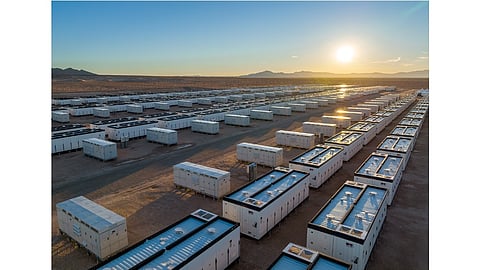


Alsym Energy, a developer of non-flammable sodium-ion batteries, and ERITY have signed a 9 GWh Strategic Relationship Agreement (SRA) to jointly develop and deploy battery energy storage systems (BESS) for mining applications. The partnership combines Alsym Energy's sodium-ion battery technology with ERITY's mining expertise to support off-grid energy storage projects. The companies will initially focus on mining operations, where diesel remains the primary power source.
The agreement includes plans to deploy Alsym's battery technology across Volt Resources Limited’s and Resource Minerals International Limited’s existing and planned mining projects in Tanzania, Saudi Arabia, Finland, and the US, and to pursue projects with other mining companies. The collaboration will target renewable-powered microgrids, critical mineral extraction and processing, AI-enabled mobile data centers, electric mining equipment and mobile BESS solutions. They have also identified future opportunities in EV charging infrastructure, commercial and industrial applications, and utility-scale energy storage.
Vena Energy, the Singapore-headquartered independent power producer (IPP), has secured approximately AUD 1.4 billion in green financing facilities to support its solar and BESS portfolio across Australia. The financing is structured through 2 transactions that combine funding for new projects with the refinancing of existing assets. It supports 614 MW of solar capacity, including operational and under-construction projects, and 1.14 GWh of battery energy storage capacity across South Australia, Queensland, and New South Wales.
According to the company, the financing structure aligns long-term capital with a mix of operating and developing renewable energy assets, improving funding efficiency and supporting future growth. The financed solar assets are expected to generate enough renewable electricity to power around 198,000 Australian households annually. The financing was backed by a consortium of international and Australian lenders, including BNP Paribas, Bank of China, DBS Bank, ING, Intesa Sanpaolo, Mizuho Bank, MUFG Bank, OCBC, SMBC, Sumitomo Mitsui Trust Bank, and Westpac.
MVM Tisza Power Plant Ltd. has commissioned a BESS with 31 MW/62 MWh capacity at its Tiszaújváros site in Hungary. The nearly HUF 10 billion project received HUF 4.185 billion in non-refundable funding under Hungary's Recovery and Resilience Plan, backed by the European Union (EU) and the Hungarian government. The lithium-ion, containerized battery system is designed to improve grid flexibility by responding within seconds to changes in electricity production and demand, according to the Hungarian state-owned energy group.
The storage facility operates alongside an existing battery system and complements the planned 1 GW combined-cycle gas turbine (CCGT) power plant under development at the same site. While these facilities will operate independently, MVM said they will together create a modern energy hub, combining fast-response battery services with flexible gas-fired generation to support Hungary's growing electricity demand and energy transition goals. Separately, MVM also completed the Bakony Hybrid Power Plant in Ajka by adding a 57 MW/57 MWh BESS to its existing gas turbine power plant.
Ceigall India Limited has signed a power purchase agreement (PPA) for a 220 MW solar and BESS project at Morena Solar Park in Madhya Pradesh. The agreement was signed through its wholly owned subsidiary, Ceigall Morena Solar BESS Park Limited, with Rewa Ultra Mega Solar Limited. The tariff-based project, valued at around INR 1,700 crore (including GST), will combine solar generation with battery energy storage to improve grid reliability.
It has an 18-month construction period, followed by a 25-year operational term, with a discovered tariff of INR 2.70/kWh. Ceigall says this expands its business beyond transportation and civil infrastructure into the renewable energy sector.
