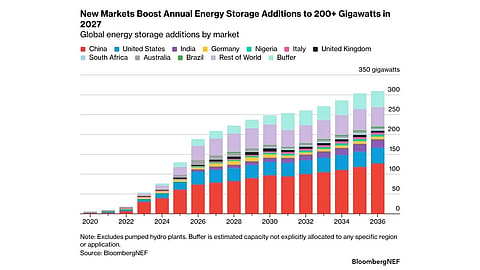


BloombergNEF forecasts energy storage additions to reach 188 GW/535 GWh in 2026 and 209 GW/638 GWh in 2027
It expects annual additions in India to exceed 6 GW in 2026, supported by tender-driven procurement
Analysts highlight that rising solar penetration and supply-chain localization policies are reshaping deployment and battery manufacturing
Global energy storage installations are set to reach a new record in 2026 with 188 GW/535 GWh, forecasts Bloomberg New Energy Finance (BloombergNEF). The market is expected to set another record in 2027, with annual additions reaching 209 GW and 638 GWh.
In its latest energy storage market outlook, BNEF forecasts 2026 global additions to represent a 45% year-on-year (YoY) increase in GWs.
Analysts attribute the expected growth to rising solar penetration, government policies promoting storage and growing demand for electricity. Deployment is now expanding beyond China and the US, as India, Australia, and several European markets accelerate battery adoption, they point out.
China, the US, and Australia are expected to account for 62% of global additions in 2026. China’s energy storage market remains strong despite the withdrawal of a policy mandating storage for renewable projects. New measures, including output-firming requirements for standalone solar and wind projects and a 300 GW storage target by 2030, are supporting growth.
The storage market grows in the US thanks to tax credits and on-site energy storage demand from data centers, while India’s tender-driven annual additions will likely exceed 6 GW of total installations this year, up from a 'few hundred megawatts' last year, according to BloombergNEF.
Deployment is also spreading to new markets as countries seek to integrate more renewable energy, improve grid flexibility, and strengthen domestic battery supply chains.
Several European countries are also expected to make larger contributions in 2026. Bulgaria, Romania, Poland, France, Greece, the Netherlands, and Ukraine are among the markets forecast to reach gigawatt-scale annual additions.
In 2027, Spain, the UAE, Chile, and Japan are expected to accelerate deployment, supported by power market fundamentals, diversified revenue stacks, and utility-led procurement activity.
The growing share of solar power in electricity generation is increasing the need for storage. Batteries can store surplus electricity when generation is high and release it when demand rises, or solar output falls. By the end of 2025, approximately 69 GW of energy storage power capacity, equivalent to 196 GWh of energy capacity, was paired with around 299 GW of solar capacity globally, according to the analysts. China accounts for a substantial share of solar-plus-storage installations.
Solar curtailment and the decline in electricity prices during periods of high solar generation are among the factors encouraging storage deployment in markets such as the US, Australia, and Chile.
However, the trend is spreading, with countries including India, Mexico, and the Philippines introducing regulatory or auction-linked requirements to promote battery integration with renewable energy projects.
BloombergNEF expects renewable energy projects paired with storage to remain an important source of deployment growth in the coming years.
The US has introduced tariffs and incentives to support domestic battery production, alongside restrictions affecting equipment and supply chains linked to China. The European Union and Japan are also addressing supply-chain security and cybersecurity concerns.
These policies could make market access more difficult for some Chinese suppliers. In response, Chinese equipment manufacturers are increasingly exploring markets with fewer restrictions, including the Middle East, Latin America, and sub-Saharan Africa.
India, South Korea, and Brazil have also introduced measures intended to encourage domestic production and the use of locally manufactured components, although their approaches are less stringent than those in the US, according to BNEF.
In terms of technology, despite growing interest in alternative battery technologies, lithium iron phosphate (LFP) is expected to remain the primary battery chemistry for energy storage over the next decade. BNEF attributes its expected dominance to cost competitiveness, long cycle life, and an established supply chain.
Sodium-ion batteries are also gaining attention amid rising prices for LFP materials. They offer advantages such as a lower risk of fire and the ability to operate across a wide temperature range, potentially reducing cooling requirements and auxiliary energy consumption.
However, limited manufacturing scale and challenges in competing on cost remain barriers to wider adoption of sodium-ion and other non-lithium long-duration storage technologies.
BNEF expects cumulative global energy storage capacity to grow approximately tenfold by 2036 compared with the end of 2025, reaching around 3 TW of power capacity and 11 TWh of energy capacity.
