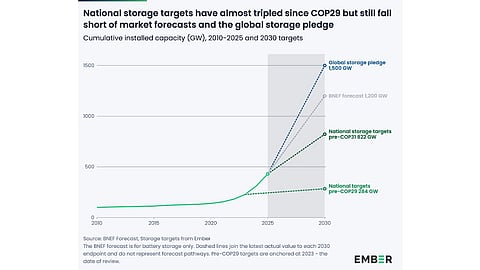


Ember says that global energy storage targets rose 190% from 284 GW before COP29 to 822 GW
China and the EU alone account for over 80% of the world’s national storage targets
Global energy storage additions exceed national targets that remain 45% below the 1,500 GW global pledge
Global energy storage targets have nearly tripled since COP29, reaching a combined 822 GW for 2030 across 99 countries and the EU. However, the total remains 45% below the 1,500 GW global goal agreed by 74 countries under the COP29 Global Energy Storage and Grids Pledge, according to a new analysis by energy think tank Ember.
The report is titled Storage target ambition is rising, but not fast enough to reach the goal.
Before COP29, the cumulative storage target globally totaled 284 GW, and it has now increased by 190% to 822 GW. The increase is driven largely by China and the European Union (EU), which together account for more than 80% of national storage targets worldwide.
China raised its 2030 target by 330 GW to 460 GW under its 15th Five-Year Plan, while the EU agreed on its first bloc-wide storage target of 200 GW in June 2026 (see AccelerateEU Backs 200 GW Storage Ambition By 2030).
Beyond these regions, only India (51 GW), Australia (33 GW), the UK (27 GW), Italy (23 GW), Spain (23 GW), and Vietnam (22 GW) target over 20 GW capacity.
“Almost all of the increase in global storage ambition since COP29 comes down to two economies: China and the EU. Most other major solar markets still haven't set a 2030 storage target at all. And that's a missed opportunity, because storage targets give investors the certainty to build,” said Dr. Katye Altieri, Global Program Consultant, Ember, and the author of the report.
Ember also highlights the link between solar and storage ambitions, since storage helps reduce solar curtailment while easing grid stress. It says that countries that set higher storage targets generally have larger solar targets.
Yet, eight of the world's 20 largest solar markets still lack a national 2030 storage target, including the US, Germany, and Saudi Arabia. While these countries are already deploying storage at scale, Ember argues that clear targets can provide investment certainty and help address regulatory barriers, operational planning, and coordination between renewable energy and storage.
Nevertheless, storage deployment continues to accelerate far beyond the combined national targets, driven mainly by falling battery costs, which have dropped by around 20% annually on average over the past decade.
In 2025, annual additions totaled 118 GW (40% year-on-year jump), including 108 GW of battery storage, reaching a combined 430 GW at the end of last year.
If annual storage additions of 118 GW were continued through to 2030, analysts believe global cumulative energy storage would reach 1,020 GW, 24% above the 822 GW sum of national targets. BloombergNEF sees potential for battery storage alone to account for 1,200 GW capacity by 2030, including 158 GW projected to be added in 2026, or an annual increase of 46%. Reaching 1,200 GW of battery storage by 2030 would require additions to increase by only 1.4 times over the next four years, according to the report.
Battery storage is expanding exponentially compared to solar and wind, which took 9 years and 15 years, respectively, to reach their initial 100 GW global installed capacity. In comparison, battery storage additions rose from 10 GW to 100 GW in four years. Battery additions rose by 17-fold in the last five years, according to the report.
Altieri stressed, “The current pace of deployment is well ahead of what governments have committed to, such that storage target ambition could be increased.”
In a related analysis for TaiyangNews, Ember’s Global Program Consultant Dr. Katye Altieri examines why national storage targets remain necessary despite rapid deployment growth. The OpEd explores why governments should continue setting targets even as storage markets expand without them (see Energy Storage Is Booming. Why Do Targets Still Matter?).
Ember said expanding storage capacity will also be important to support the proposed 35-by-35 Global Electrification Pledge ahead of COP31, which aims to increase electricity's share of final energy demand from around 20% to 35% by 2035 (see IEA: Electrification Could Save $400 Billion By 2035).
Meeting the additional demand with renewable energy will require adequate grid infrastructure and energy storage, the think tank noted.
The complete Ember report is available for free download on its website.
