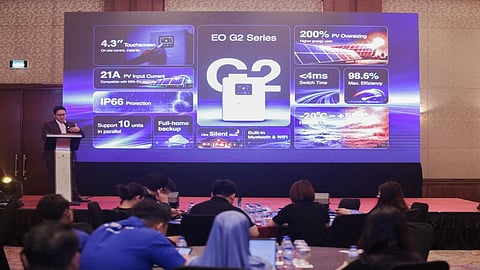

GoodWe has pitched its 1-phase EOG2 series off-grid inverter and Lynx A G4 16 kWh battery for residential consumers without a grid supply
According to the company, it offers single-inverter and multiple-inverter-based microgrid solutions for remote islands
The company’s multiple-inverter microgrid can deliver up to 660 kW of dispatchable power to a remote community
GoodWe, a well-known provider of PV inverters and energy storage systems (ESS), recently concluded its Indonesian roadshow, where it
promoted residential off-grid and custom-built microgrid solutions for the country’s remote islands and villages without any grid supply.
The company pitched the EO G2 off-grid inverter and the Lynx A G4 16 kWh low-voltage battery for residents with unreliable or no grid connection. This off-grid 1-phase inverter with 2 MPPT channels can support up to 21 A PV input per string and up to 200% DC/AC overcapacity to maximize solar harvesting across the daily sunny period. It can deliver up to 6 kW AC at full load. The 51 V battery with its 16 kWh storage capacity is coupled with the inverter to form an off-grid home storage system. However, whole-home backup requires further capacity expansion and a direct connection to a generator. For this, it supports the parallel operation of up to 10 inverter units (a total of 60 kW) and the connection of a diesel generator (DG). The company notes that users can enable ultra-silent mode during nighttime operations.
The company offers 2 types of microgrid solutions for remote applications, such as a remote village with multiple families relying on costly DGs. A microgrid, consisting of multiple energy sources, serves as a local grid to ensure reliable, dispatchable power in the absence of a grid supply. According to the company, the single inverter-based microgrid solution is controlled by the SEC3000C energy controller. It allows connection with DGs and a PV inverter. For future additional large loads, its multi-port feature also enables direct connection to DGs and multiple additional PV inverters.
For a scalable, multiple-inverter-based microgrid solution, the company pitches a system featuring its ET series hybrid inverters and clusters of BAT-C100 series batteries. Here, an unspecified number of 16 kWh batteries are DC-coupled to up to six 100 kW hybrid inverters, forming an isolated storage plant capable of dispatching up to 660 kW of 3-phase power with a corresponding storage capacity of up to 5.376 MWh. In terms of system architecture, the company always maintains an N+1 configuration, where N is the number of active parallel-connected inverters with an additional redundant unit. Given the importance of maintaining full dispatchable power to all the connected island consumers, the redundant unit quickly becomes active once an inverter goes down mid-operation.

