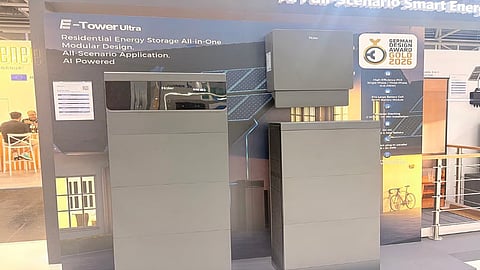

Haier Energy launched its E-Tower Ultra series residential ESS at the show
This ESS has 3.6-12 kW/8-64 kWh single-phase, and 8-20 kW/8-64 kWh 3-phase variants
These are scheduled to be commercially available by Q3 or at the start of Q4 2026
Haier Energy, a home appliance-turned energy storage system (ESS) provider, showcased its latest product, E-Tower Ultra, at Intersolar Europe 2026 for Europe’s residential prosumers, who are facing rising electricity costs and energy price volatility.
This product, either with a single- or 3-phase hybrid inverter, can be mounted on top of 8 modular battery packs (each of 314 Ah and 8 kWh capacity) in a cable-free tower configuration for simplified installation and commissioning. The former, with an inverter capacity range of 3.6 to 12 kW, can connect to storage capacities between 8 and 64 kWh. In contrast, the 3-phase variant offers an 8-20 kW/8-64 kWh ESS.
Both variants are designed to carry up to 200% DC/AC overcapacity compared to the rated full-load power output (AC) to maximize solar harvesting. In addition to the PV contribution, its integrated energy management system is embedded with AI algorithms that analyses dynamic electricity tariffs with prosumer or consumer load patterns, as per the company.
Based on this analysis and the algorithm’s intelligence, battery charging and discharging scheduling can be adjusted to tariff slots with low and high rates, respectively. As a result, it explained, this helps users optimize grid power consumption, maximize PV self-consumption, and reduce electricity bills.
The company’s HEvision platform, when integrated with its EMS, can also perform real-time weather forecasting. Meanwhile, in the event of a grid outage, this system switches to off-grid mode within 0 ms and provides emergency backup support for the continued operation of household loads. The system also supports integration with a diesel generator (DG) and a bidirectional EV charger via an external gateway for extended backup support, added Haier.
This showcased product is expected to be commercially available by Q3 or at the start of Q4 2026.

