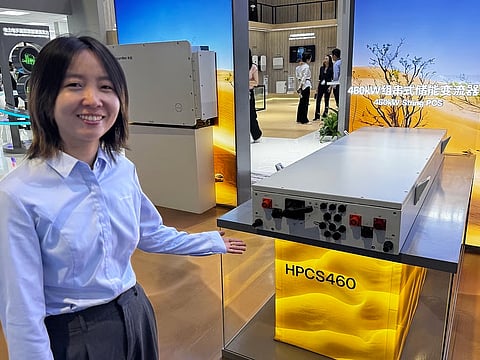

Hoymiles’ latest HPCS460 series string PCS offers battery rack-level conversion operation rather than controlling a centralized battery bank
The company claims a maximum conversion efficiency of more than 99%
It maintains power delivery accuracy within ≤1% of rated power
Module-Level Power Electronics (MLPE) and solar-plus-storage system provider Hoymiles highlighted its latest 3-phase power conversion system (PCS), HPCS460, designed for an AC-coupled utility-scale battery energy storage system (BESS) connected to the grid.
A PCS is a bidirectional power electronics converter (DC-to-AC and AC-to-DC) that serves as an intermediary between the battery and grid and possesses grid-interactive functions compared to a conventional battery inverter. It also eliminates the need to replace old grid-tied inverters to add greenfield storage capacity with the existing PV array.
The latest PCS, which is rated for a maximum charging/discharging capacity of 460 kW, is categorized as a string type. Unlike a centralized PCS, which controls a whole battery bank, it offers a distributed architecture with multiple connected PCSs. As a result, it enables battery rack-level control, enhancing operational and maintenance flexibility. This PCS has a 3-level converter topology with an Active Neutral Point Clamped (ANPC) architecture (at the midpoint of the DC bus) that facilitates 3 DC voltage levels: +Vdc/2, 0, -Vdc/2. According to the company, this attribute creates lower voltage stress on power devices and reduces switching losses, which are proportional to DC bus voltage and current, compared to a standard 2-level converter. Together, these benefits contribute to a PCS conversion efficiency of over 99%, claims Hoymiles.
In terms of thermal efficiency, a circulating liquid coolant helps the PCS maintain full-load operation even at 60°C. The company added that this PCS can maintain actual power delivery within an accuracy level of ≤1% of rated power, enabling accurate power dispatch and grid ancillary support.

