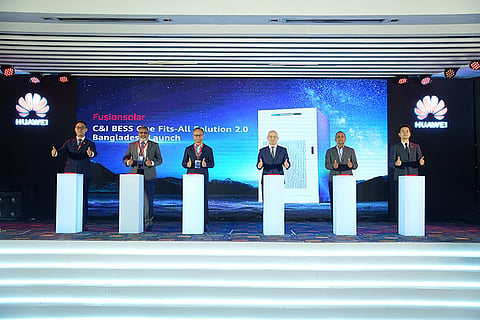

Huawei’s LUNA2000-241KWH-2S1 series was launched during a launch event in Dhaka
The ESS has a built-in C2C electrical and thermal runaway protection, covering battery cells to the consumption side
It also features a heating and cooling mechanism that automatically switches according to real-time operational temperature
Huawei Digital Power, one of the leading providers of PV-plus-storage systems, launched its LUNA2000-241KWH-2S1 series energy storage system (ESS) for Bangladesh’s commercial and industrial (C&I) applications during a launch event in Dhaka.
The country’s C&I consumers are facing challenges in balancing between OpEx and energy stability. Huawei says it has developed its latest ESS to cater to such needs. It is equipped with 4 vertically stacked LFP battery packs, and offers a cumulative storage capacity of up to 241 kWh and a DC busbar voltage range of 642 V to 852 V. This voltage is transmitted to the upstream via a subsequent 108 kW 3-phase power conversion system (PCS), making an AC-coupled configuration.
Huawei adopts multiple strategies to maximize the utilization of stored energy, whether from solar or grid sources. One is that each battery pack can deliver a depth of discharge (DOD) of up to 100%, eliminating any redundant capacity. In parallel, its built-in active charge and discharge balancing function maintains optimal balance across all connected battery units in real time. This, in turn, helps the system maintain a steady state of health (SOH) throughout its operational lifecycle, preventing a drop in cumulative capacity caused by any weak unit. Lastly, its automatic calibration of the battery bank’s state-of-charge (SoC) always keeps a check between actual and displayed status, unlike the scheduled manual O&M practice.
Beyond active optimization, the company focuses on operational heat control, which is also responsible for charge wastage, albeit passively. For this, the ESS features a cooling mechanism that switches between multiple modes according to high (liquid-cooled) and room-temperature (natural air-cooled) conditions. It also recycles PCS waste heat to heat up in low temperatures. Characterizing it as ‘hybrid cooling’, the company states that active and passive charge and discharge optimization help achieve a round-trip efficiency (RTE) of up to 91.3%.
In terms of safety, this ESS features a safety architecture that starts from the battery cell to consumption. It comprises both electrical and thermal runaway protection. The former features dual cell detection that detects faults and sends warnings via a cloud-based system. It also has overcurrent protection covering the AC and DC sides. To protect against thermal runaways, it uses cell-level heat insulation, system directional gas exhaust, an external oxygen barrier, and a top explosion vent. The company notes that this ‘C2C dual-link safety architecture’ ensures a reliable energy supply to C&I prosumers.
The status of this product’s commercial availability in the country was unknown at the time of publication.

